
Far Right 'Show of Force' at Heavily Policed London Rally
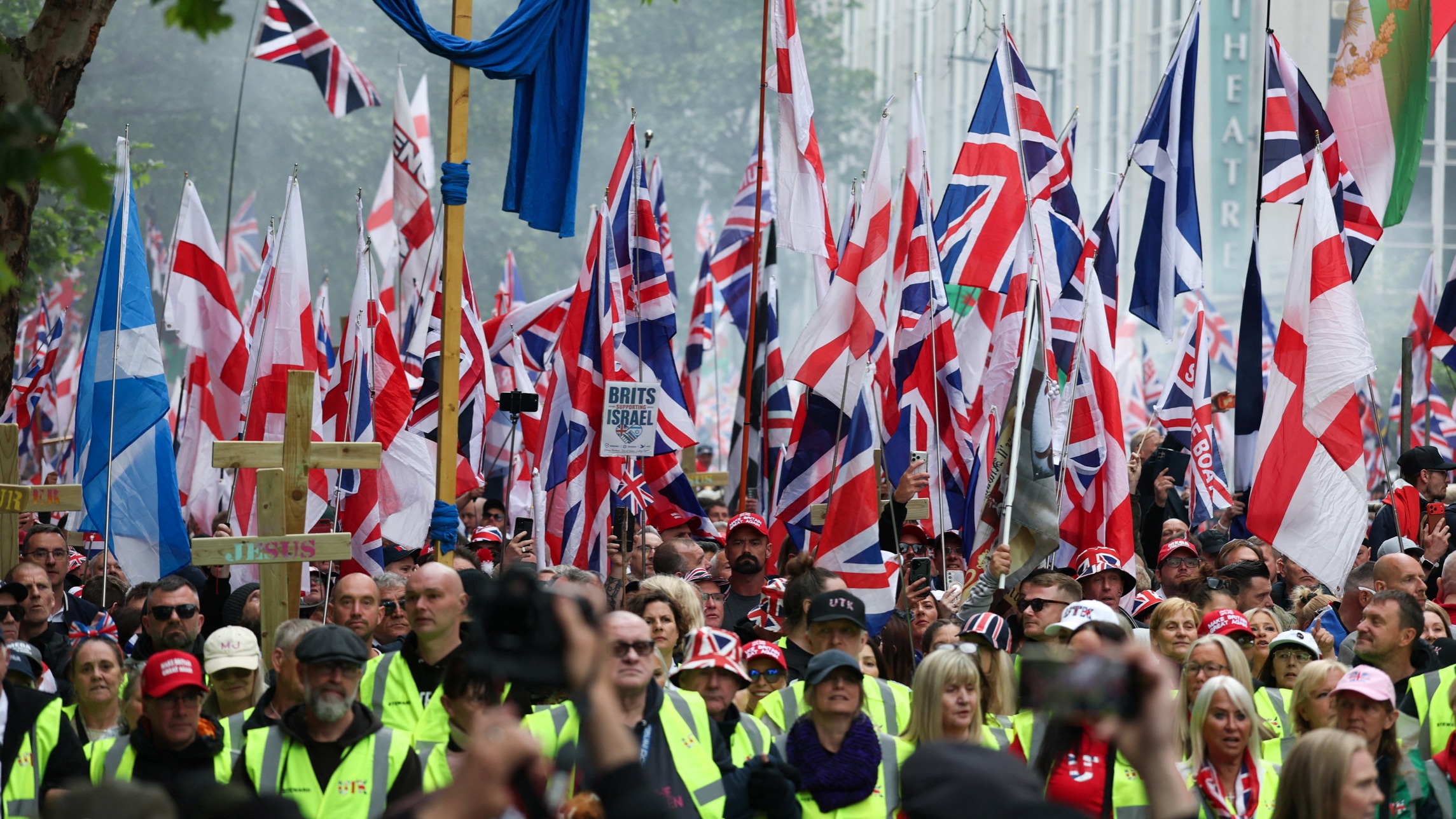
Protests in London Highlight Tensions and Security Measures
Tens of thousands of people participated in rival protest marches in London on Saturday, showcasing a stark divide between far-right groups and those advocating for racial equality and Palestinian rights. The events underscored the ongoing challenges faced by authorities in managing public demonstrations while maintaining safety and order.
One of the notable gatherings was led by far-right activist Stephen Yaxley-Lennon, who claimed the Unite the Kingdom march would be an unprecedented "show of force" by the UK's far-right. However, the Metropolitan Police estimated that the turnout was significantly lower than the 150,000 attendees at a similar event last year. A police officer estimated the number at around 60,000, indicating a drop in participation compared to previous years.
To ensure public safety, the Met deployed 4,000 officers across the city. These officers were not only responsible for monitoring the Unite the Kingdom march but also for managing a rival rally organized by Stand up to Racism and other groups opposing racism and supporting the rights of Palestinians. Some of the officers were also tasked with securing the FA Cup final at Wembley, highlighting the scale of the security operation.
The police aimed to prevent a recurrence of the violent confrontations that occurred during a similar event in September, when Yaxley-Lennon's Unite the Kingdom gathering overwhelmed law enforcement. Despite these concerns, the Met reported that both protests took place "largely without significant incident." A member of the Met staff estimated that the pro-Palestinian march had between 15,000 and 20,000 participants.
Yaxley-Lennon claimed that his event attracted millions of people, while Stand up to Racism asserted that 200,000 individuals attended their rally. This discrepancy in attendance figures highlights the subjective nature of protest counts and the potential for differing narratives.
UK Prime Minister Sir Keir Starmer criticized Yaxley-Lennon's remarks as evidence of "hatred and division, plain and simple." Starmer, who visited the Met’s command and control special operations room on Friday to show support for the police, emphasized the importance of addressing such sentiments. He stated, “We’re in a fight for the soul of this country, and the Unite the Kingdom march this weekend is a stark reminder of exactly what we are up against.”
The Met’s deputy assistant commissioner, James Harman, expressed concerns about the factors surrounding the marches, stating that they gave the force "significant cause for concern." In response, the Met introduced new powers to hold organizers accountable for any unlawful incitement to violence or hate speech made by speakers at post-march rallies.
For the first time, the Met deployed a live facial recognition system near the Unite the Kingdom march to identify attendees wanted for criminal offenses. This technology was used at a location where protesters gathered before the march, rather than during the event itself, according to the force.
By Saturday evening, 43 arrests had been made across both rallies, with the Met noting that while this number may seem high, the protests had largely proceeded without major incidents. Footage shared on social media showed police surrounded by an angry crowd while making an arrest at Euston station.
West Midlands police reported the arrest of a 44-year-old man on suspicion of wounding following a collision involving a van and a pedestrian in Stirchley. The pedestrian, a man in his thirties, sustained leg injuries and remains in hospital.
Controversy also arose over apparent antisemitic incidents at both marches. Some protesters at the pro-Palestinian event engaged in chanting slogans that the Met had warned could lead to arrests. It was unclear whether those involved were among the arrested individuals.
At the Unite the Kingdom march, a group carried a banner reading “End Zionist occupation of Britain: stop white replacement.” The Met declined to comment on whether the banner constituted unlawful hate speech. It was also unclear if any of those involved were arrested.
These protests followed a series of antisemitic attacks in London, including the stabbing of two Jewish men in Golders Green on April 29. Incidents mainly attributed to an Iran-linked group, Ashab al-Yamin, have prompted some Jewish groups to call for tighter controls or bans on pro-Palestinian protests to curb what they perceive as antisemitic hate speech by some participants.
Post a Comment for "Far Right 'Show of Force' at Heavily Policed London Rally"