
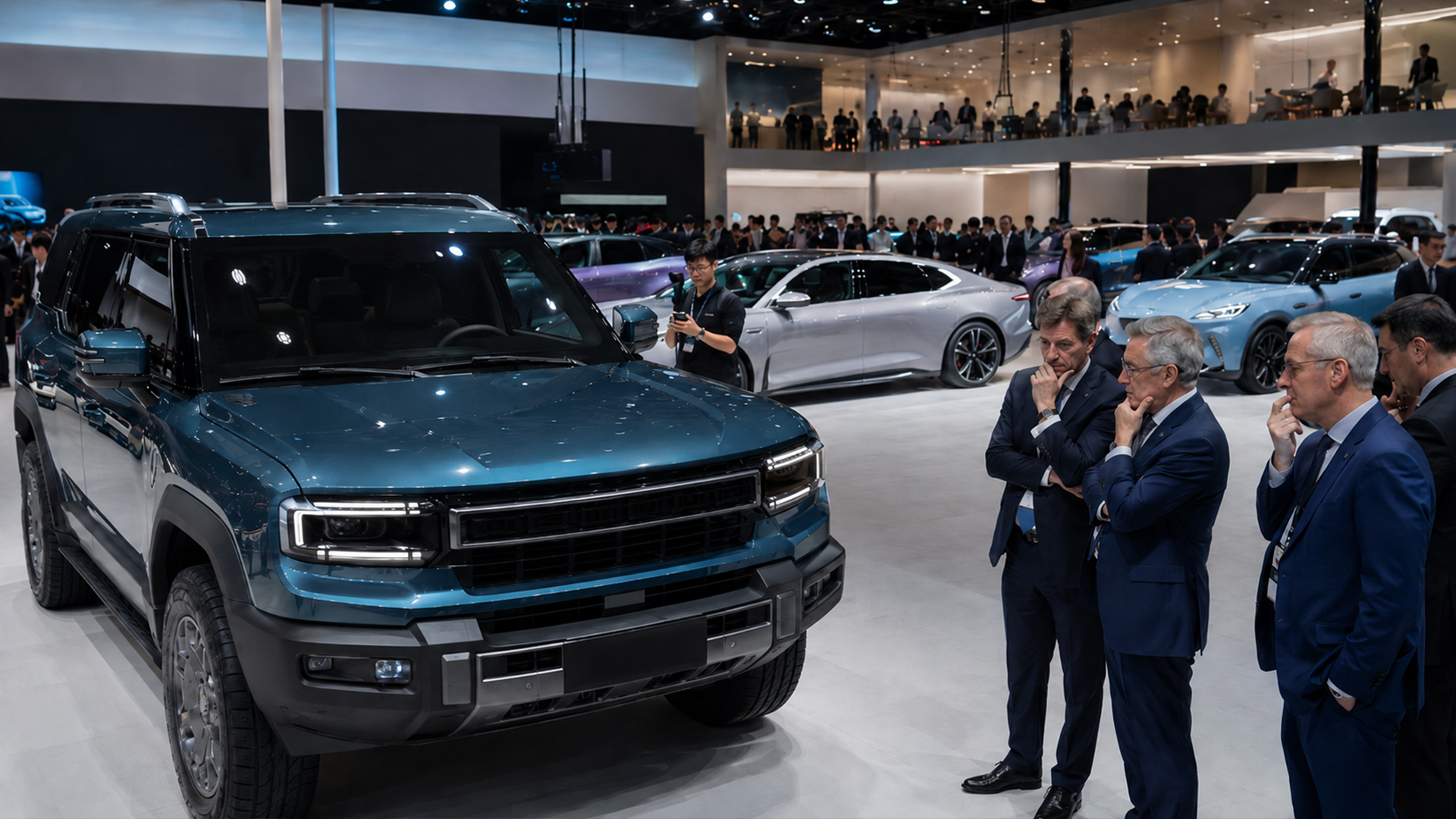
The Fear Is No Longer About Cheap Cars
For decades, Western automakers have viewed China primarily as a vast market for sales. However, this perspective is shifting as many of them now see China as a formidable threat.
The transformation lies in the fact that Chinese car brands are no longer just producing affordable vehicles. They are creating cars that are modern in design, well-equipped, and equipped with advanced battery technology, strong software features, and often come at a lower price than their European and American counterparts.
This shift is what makes the current situation so different. A low price was once not a major concern if the product felt clearly inferior. What is causing anxiety among traditional automakers is that the best new cars from China no longer feel like budget compromises.
There was an old belief that Chinese brands would need years to catch up. In the electric vehicle (EV) space, many have already done so.
China Became the Center of the EV World
The scale of China’s rise in the EV market is difficult to overstate. According to the International Energy Agency (IEA), electric car sales in China increased by almost 40% in 2024, accounting for nearly two-thirds of global electric car sales that year. Electric cars also made up close to half of all car sales in China for the full year.
This domestic scale gives Chinese automakers a significant advantage. They can test products in the world's largest EV market, learn quickly from consumers, reduce costs through volume, and then export improved models overseas. The IEA also reported that over 11 million electric cars were sold in China in 2024, surpassing global EV sales just two years earlier.
For Western brands, this means China is not just another competitor—it is an industrial system moving at an enormous speed.
The Price Gap Is the Weapon
Chinese cars are unsettling for legacy brands because the price gap is often hard to explain to consumers. In Europe, buyers are seeing Chinese EVs and plug-in hybrids arrive with large screens, extensive equipment lists, competitive range, fast charging, and advanced driver-assistance features. In some cases, they are priced far below comparable models from German, French, Korean, or American brands.
Reuters reported that Chinese automakers such as Geely and Nio are now targeting customers of premium German brands including Porsche, Mercedes, and BMW, offering feature-packed premium models at significantly lower prices. This strikes at the heart of the old European advantage.
German brands built decades of strength around engineering, quality, and prestige. Chinese brands are now trying to tell customers that software, batteries, cabin technology, and value matter more than tradition.
Europe Is Already Feeling the Pressure
Europe is the most visible battlefield because Chinese brands can sell there more easily than in the United States. Chinese automakers nearly doubled their combined European market share to 5.1% in the first half of 2025, according to Reuters, which is close to Mercedes-Benz’s 5.2% share.
While this number is still small compared to companies like Volkswagen Group, Stellantis, Renault, BMW, Mercedes, and Hyundai-Kia, the speed of the increase is what alarms the industry.
A few years ago, many European buyers barely knew names like BYD, Nio, Xpeng, Zeekr, Leapmotor, or Chery. Now those brands are turning up at European motor shows, entering dealer networks, launching SUVs and sedans, and challenging the idea that a serious car must come from Europe, Japan, Korea, or America.
That is why Europe has imposed tariffs on China-made EVs. The European Commission adopted additional duties in 2024 after investigating Chinese EV subsidies, with rates including 17% for BYD, 18.8% for Geely, and 35.3% for SAIC, while Tesla’s China-made cars received a lower 7.8% rate.
Tariffs may slow the pressure, but they do not remove it.
America Is Protected, But Not Comfortable
The United States is in a different position. Chinese-brand cars are effectively kept out of the U.S. market by politics, tariffs, security concerns, and trade barriers. That gives Detroit more breathing room than European brands have. But breathing room is not the same as safety.
Reuters reported that some U.S. buyers are interested in affordable Chinese EVs they cannot currently buy, while the average new vehicle price in America has been near $50,000. That is a dangerous contrast.
If American buyers are struggling with high prices, and Chinese automakers can build attractive EVs for far less, the pressure does not disappear just because the cars are blocked. It builds outside the wall.
That is why U.S. policymakers and auto lobby groups have pushed not only against Chinese imports, but also against Chinese automakers potentially building in Mexico or Canada to access North America. Reuters reported that U.S. senators and auto groups have called for restrictions on Chinese automakers building U.S. factories or entering through neighboring markets.
Detroit knows the threat is not theoretical. It is delayed.
The Real Advantage Is Speed
Price matters, but speed may matter even more. Reuters found that Chinese automakers’ rapid development cycles have become one of their biggest advantages. Faster development saves capital, keeps showrooms fresh, and lets brands respond quickly during a technology shift.
That is a major problem for older automakers. Traditional car companies often take years to develop a new platform, approve styling, validate hardware, build supplier systems, and launch globally. Chinese EV makers, especially those built around software, batteries, and vertical integration, can update faster.
That changes customer expectations. A car that looks new in Europe or America may feel old in China after only a couple of years. Features such as large screens, over-the-air updates, advanced driver assistance, voice control, high charging speeds, and connected services are no longer luxury extras in China. They are becoming baseline expectations.
Western automakers are not only competing against cheaper cars. They are competing against a faster product rhythm.
Legacy Brands Are Being Squeezed From Both Ends
European and American automakers face pressure at the bottom and the top. At the lower end, Chinese brands can offer small EVs and compact SUVs at prices that are difficult for Western brands to match profitably. At the higher end, Chinese brands are moving into premium territory with models that challenge German luxury cars on performance, interior technology, and equipment.
That creates a squeeze. If Western brands cut prices, they risk destroying margins. If they keep prices high, they risk losing buyers who no longer believe the badge justifies the premium. If they slow-walk electrification, they fall behind on battery and software. If they rush EVs, they may lose money on expensive platforms and underused factories.
This is why companies like Stellantis are discussing very low-cost European EVs. Reuters reported that Stellantis plans a small electric car around €15,000, partly to revive Europe’s entry-level market and compete with cheaper EVs. That kind of move shows the pressure is real. Europe’s giants are being forced to think smaller, cheaper, and faster.
China’s Domestic Price War Makes Exports More Aggressive
There is another reason Chinese brands are pushing outward: China’s own market is brutally competitive. A domestic price war has forced automakers to cut prices and fight for share. Reuters reported that BYD slashed prices on more than a dozen models in 2025, contributing to fears of an industry shakeout in the world’s largest car market.
That matters globally. When competition at home becomes harsh, Chinese automakers look abroad for growth and higher margins. Europe, Southeast Asia, Latin America, Australia, and the Middle East become attractive targets. The U.S. is harder to enter, but Chinese companies are still exploring nearby production and export strategies.
Reuters’ Breakingviews reported that Chinese automakers are aiming to almost triple overseas production by 2030, while exports now make up around a third of total sales. In other words, Chinese expansion is not a temporary wave. It is becoming a long-term survival strategy.
Western Brands Still Have Strengths
The story is not one-sided. European and American brands still have powerful advantages: brand heritage, dealer networks, safety reputations, performance credibility, financing structures, service support, fleet relationships, and decades of customer trust.
A Mercedes badge still means something. A Porsche still has emotional pull. Ford trucks still dominate parts of the U.S. market. Jeep, BMW, Audi, Cadillac, Chevrolet, Volvo, and others still carry identities that Chinese brands cannot instantly copy.
But those strengths are less secure than they used to be. Younger buyers may care less about badge history if a Chinese EV offers more technology, more range, more performance, and a lower monthly payment. In China itself, this shift has already hurt foreign brands. The danger for Western automakers is that the same logic spreads abroad.
The Tariff Wall Cannot Be the Whole Strategy
Tariffs can buy time, but they cannot build better cars. Europe’s tariffs may slow Chinese EV growth. U.S. restrictions may keep Chinese brands away from American showrooms for now. But neither response solves the underlying problem: Chinese automakers have become highly competitive on cost, batteries, speed, and technology.
If Western brands rely only on political protection, they risk falling further behind. The more useful response is harder: simplify vehicle lineups, reduce development costs, improve software, localize battery supply, build cheaper EVs, and stop assuming customers will pay a premium for a familiar badge.
The brands that adapt may survive the Chinese challenge. The brands that treat it as a passing threat may not.
This Is the Auto Industry’s New Reality
European and American automakers are not scared because Chinese cars are cheap. They are scared because Chinese cars are increasingly good. That is the difference between normal competition and industry disruption.
A cheap product can be ignored if it feels cheap. A high-quality product at a lower price forces every rival to explain why its car costs more. For the last century, the global car industry was shaped largely by America, Europe, Japan, and later South Korea. China is now demanding a central role.
The question is no longer whether Chinese automakers can build cars the world wants. They already can. The question is whether Western brands can change quickly enough before their old advantages become expensive memories.


No comments:
Post a Comment