

Consolidation Continues
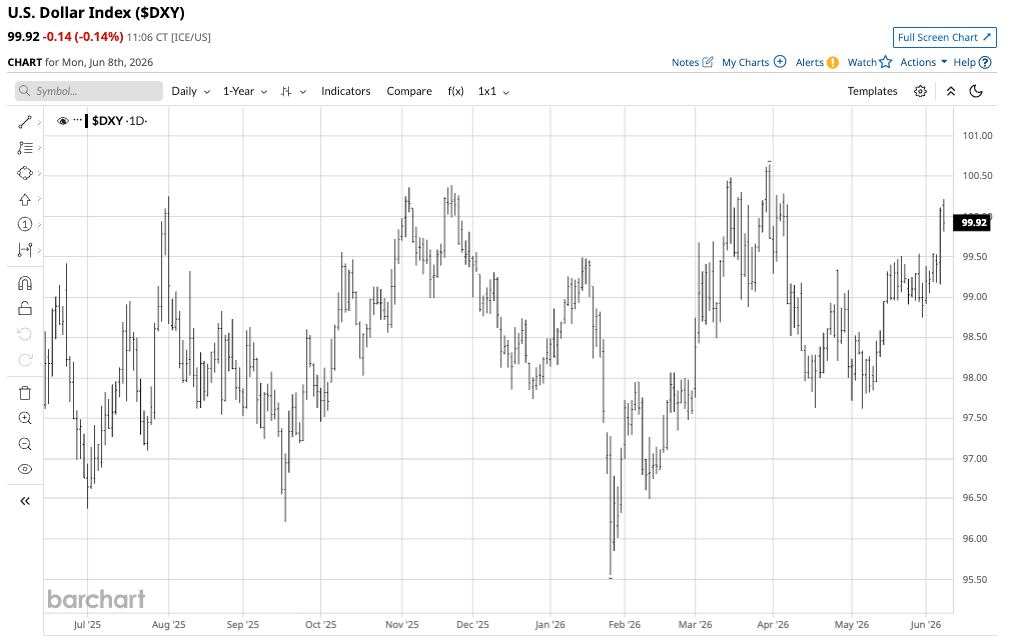
Over the past year, the U.S. dollar index has been trading within a tight 5.09 point range. This consolidation suggests that the market is in a state of equilibrium, with neither strong bullish nor bearish momentum dominating the trend. The index was trading at 97.78 in April 2026 and reached near 100 in June 2026, but it remains within a narrow consolidation range.
The daily chart reveals that this 5.09 point range includes both downside and upside extensions. On January 27, 2026, the index hit a low of 95.55, while on March 31, 2026, it surged to a high of 100.64. Despite these fluctuations, the index has mostly traded within a narrower 4.18 point range over the past year, with a pivot point around 98.50—just above the recent high and low for the period.
The Bullish Case for the Dollar Index
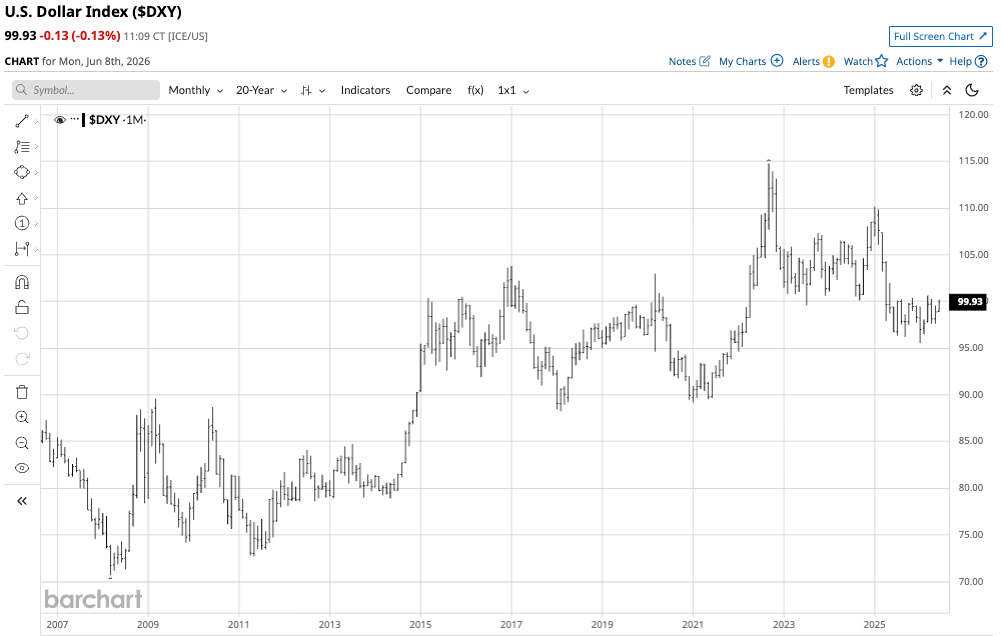
From a technical perspective, the dollar index shows a strong bullish case, as evidenced by its 20-year monthly chart. The index has consistently made higher lows and higher highs, starting from the March 2008 low of 70.69 up to the September 2022 high of 114.78. Since 2008, any downside corrections have not fallen below previous critical support levels, reinforcing the long-term bullish trend.
Fundamentally, several factors support the U.S. dollar index. The United States continues to maintain the world's leading economy, and elevated interest rates provide support for the dollar against other reserve currencies. As the global reserve currency, the dollar remains a preferred asset for central banks, governments, and monetary authorities. Additionally, during times of economic or geopolitical uncertainty, the dollar often acts as a safe haven, further bolstering its value.
These technical and fundamental factors suggest that the dollar index is likely to remain stable around the 99 level in the near term.
The Bearish Case for the Dollar Index
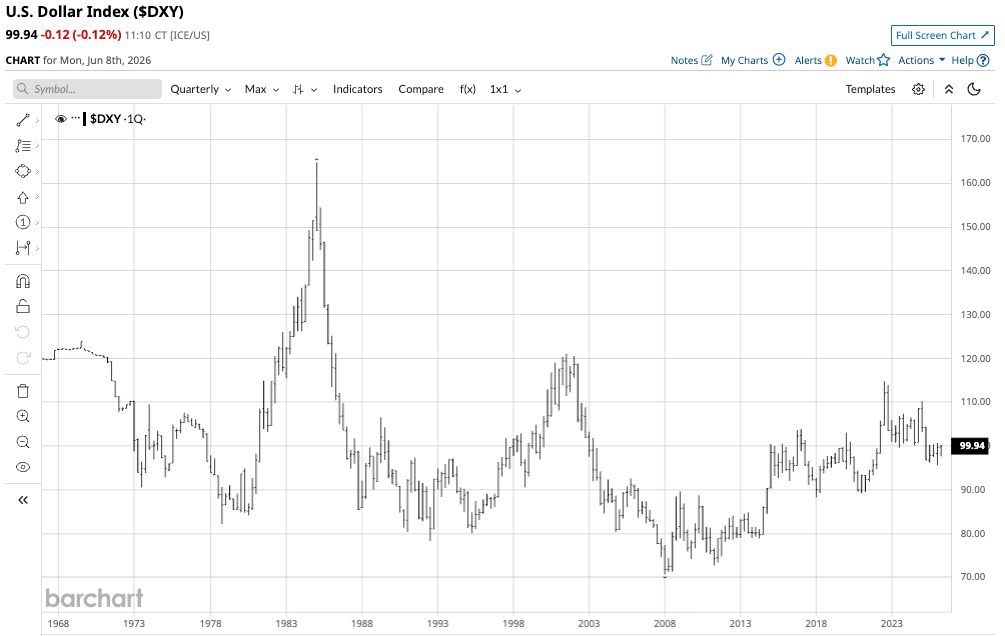
On the other hand, the bearish technical case for the dollar index is evident from its long-term quarterly chart. From the 1985 high of 174.72 to the 2008 low of 70.69, the index has made lower highs and lower lows. While it has recovered since 2008, the long-term bearish trend remains intact, as the index has yet to surpass the 2022 high of 114.78.
Fundamentally, several factors weigh on the U.S. dollar index. The U.S. debt is approaching $40 trillion, which has raised concerns about the full faith and credit of the U.S. government and its currency. Credit agencies have also downgraded U.S. credit ratings. Moreover, U.S. tariffs, sanctions, and the bifurcation of nuclear powers have contributed to de-dollarization, as more countries turn to the Chinese yuan and other foreign currencies for international trade.
Gold, often seen as a barometer of fiat currency weakness, has experienced a significant rally—from $252.50 per ounce in 1999 to over $5,600 in early 2026. At over $4,500 per ounce in June 2026, this surge highlights the weakening confidence in fiat currencies, including the U.S. dollar. Additionally, U.S. trade policy and relations with allies have weakened key alliances, further impacting the dollar’s strength.
Technical Levels Remain Intact
Since 2008, the long-term technical support for the dollar index has been at 70.69, with technical resistance at 114.78—a 44.09 point range. This is more than 8.5 times the range observed over the past year.
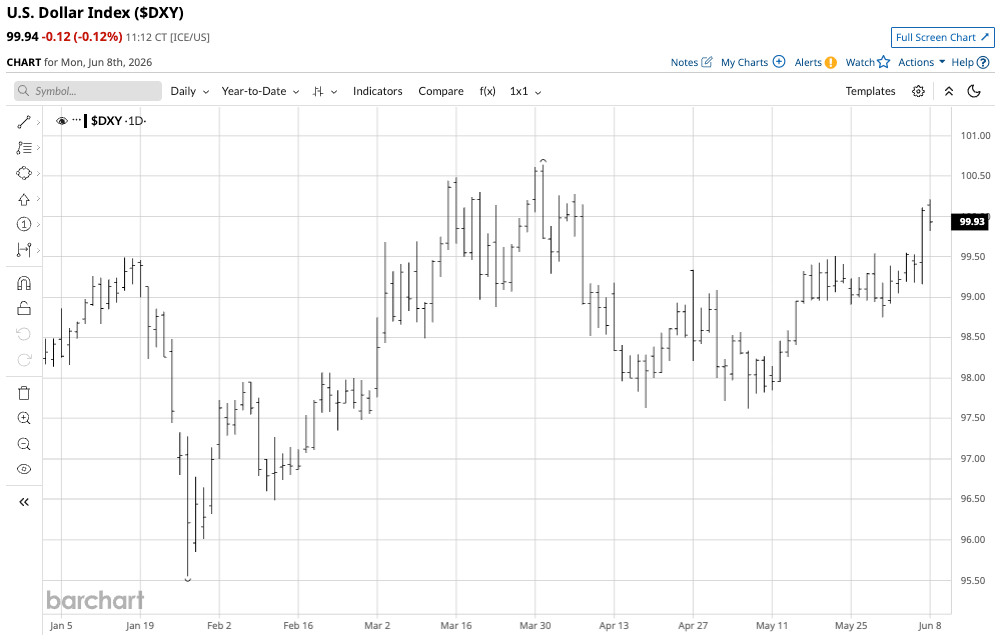
The year-to-date chart shows that the first short-term upside target is the March 31 high of 100.64, with technical support at the May 6 low of 97.62 and the January 27 low of 95.55. A move beyond these levels could trigger a substantial shift in the index’s direction. While ICE offers liquid dollar index futures and options, ETFs like the Invesco DB USD Index Bullish Fund (UUP) and the Invesco DB USD Index Bearish ETF (UDN) closely track the dollar index’s movements.
A Balanced Case Favors Continued Consolidation
The interplay between bullish and bearish factors suggests that the dollar index will likely remain in its current 95-100 range. However, two key factors could push it beyond these levels. On the bearish side, if global de-dollarization accelerates, it could lead to a stronger euro, which would lower the dollar index due to its 57.6% exposure to the euro.
From a bullish perspective, the dollar has historically acted as a safe haven during economic or geopolitical shocks. For example, it rallied in early 2020 during the pandemic and again in 2022 after the Russia-Ukraine conflict. More recently, tensions in the Middle East led to a rise in the dollar index to its 2026 high of 100.64. Any future surprises that drive capital toward safe havens are likely to benefit the dollar.
Barring any major events, the dollar index seems poised to remain within the 95-100 range for the rest of 2026.


No comments:
Post a Comment