
Giant Invasive Spiders Hear Through Their Webs and Detect Heartbeats
A Spider That Continues to Surprise Scientists
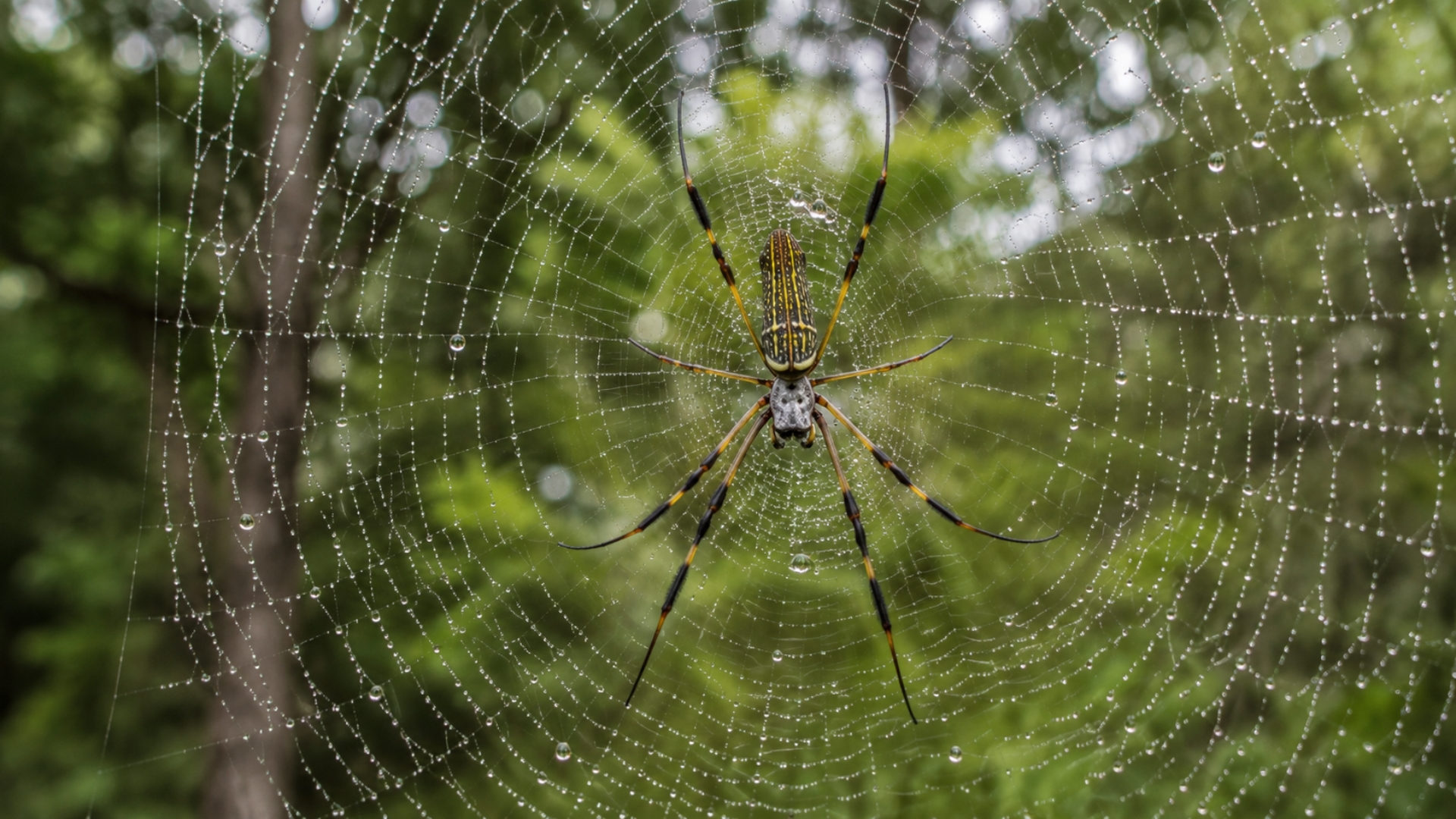
The Joro spider has become one of the most talked-about invasive species in North America. Originally native to East Asia, the species has spread across parts of the southeastern United States, drawing attention because of its large size, striking yellow-and-black coloration, and enormous golden webs.
For many people, the spider's appearance is dramatic enough. But researchers are increasingly discovering that its most impressive features may be invisible. Recent studies suggest Joro spiders possess extraordinarily sensitive abilities to detect vibrations and airborne disturbances, helping them interpret their surroundings through their webs with remarkable precision.
The Web Functions Like an Extended Sensory System
To humans, a spider web appears to be little more than a trap. For a spider, however, the structure serves as a sophisticated information network. Every strand can transmit vibrations generated by prey, predators, weather conditions, or nearby movement. Rather than relying primarily on eyesight or hearing in the way mammals do, many spiders gather information through these mechanical signals.
The Joro spider appears particularly adept at using this system. Researchers have found that vibrations traveling through web silk can provide detailed information about what is happening nearby, allowing the spider to respond quickly and efficiently. In many ways, the web acts as an extension of the animal's nervous system.
Detecting More Than Trapped Insects
Scientists have learned that spiders can interpret a surprising variety of signals. A struggling insect creates a different vibration pattern than a falling leaf. Wind produces distinct movements compared with the approach of a predator. By analyzing these differences, spiders can decide whether to attack, retreat, repair their web, or remain motionless.
Research on Joro spiders suggests they may be particularly sensitive to subtle environmental cues. Some studies indicate spiders can detect airborne sounds indirectly when sound waves cause web strands to vibrate. In essence, the web itself can function as a giant external hearing structure. This ability allows spiders to gather information from an area far larger than their own bodies.
Why Sensory Adaptability May Aid Invasion Success
One reason scientists are interested in Joro spiders is their rapid expansion into new environments. The species was first documented in the United States relatively recently, yet it has spread across multiple states. Researchers are trying to understand what characteristics contribute to this success.
A highly effective sensory system may be one factor. Animals that can efficiently detect threats, locate prey, and adapt to unfamiliar conditions often have advantages when colonizing new habitats. The ability to extract detailed information from environmental vibrations could help Joro spiders navigate a wide range of settings. Combined with their tolerance for different climates and habitats, this adaptability may help explain their continued spread.
Despite Their Size, They Pose Little Threat to People
The growing attention surrounding Joro spiders has sometimes generated concern among homeowners. However, experts generally emphasize that the species is not considered dangerous to humans. While they possess venom used to subdue prey, their bites are uncommon and are not regarded as medically significant for most people.
In many cases, the spiders prefer to avoid direct interaction. Their large size and conspicuous webs often make them appear more intimidating than they actually are. Researchers encourage people to view them as a subject of scientific interest rather than a serious public safety concern.
Spiders Are More Sophisticated Than Many Realize
Studies of spider behavior continue to challenge popular assumptions about arachnids. Although spiders possess relatively small nervous systems, they frequently demonstrate complex hunting strategies, impressive engineering abilities, and sophisticated responses to environmental information. Their webs are not passive traps but active sensory platforms that help them interpret the world.
The Joro spider provides another example of how evolution can produce highly specialized solutions to ecological challenges. What appears to be a simple web can function as a finely tuned detection system capable of gathering information from across an entire structure.
A Reminder That Nature Still Holds Surprises
The growing body of research surrounding Joro spiders highlights a broader lesson about wildlife. Even species that seem familiar or, in this case, increasingly common, can possess abilities that remain poorly understood. Scientists continue to discover unexpected sensory adaptations, behavioral strategies, and ecological interactions across the animal kingdom.
For Joro spiders, the story is about more than an invasive species spreading into new territory. It is also about a remarkable animal whose web serves as far more than a hunting tool. Through those strands of silk, the spider can detect a world of vibrations, movements, and signals that humans rarely notice. The result is a reminder that some of nature's most impressive technologies were invented millions of years before people ever began studying them.
Post a Comment for "Giant Invasive Spiders Hear Through Their Webs and Detect Heartbeats"