
How the Proximity Fuse Revolutionized Warfare Above and Below
The Impossible Radio Inside A Shell
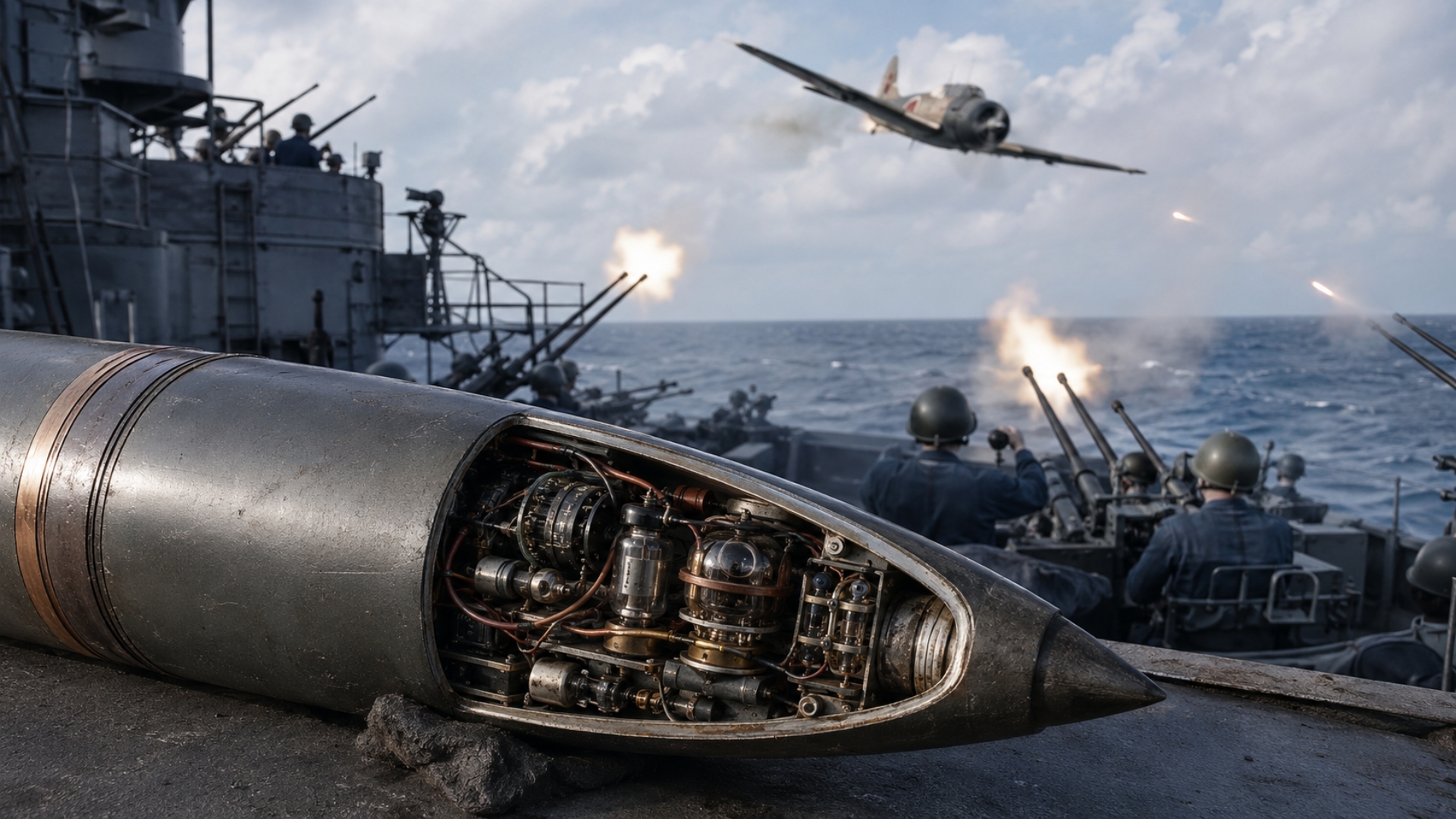
The proximity fuse was a technological marvel that seemed almost impossible at the time. It required fragile electronics to survive the extreme conditions of artillery fire. A shell launched from a naval gun experienced intense acceleration, violent spinning, vibrations, heat, and impact forces before reaching its target area. Traditional glass vacuum tubes and soldered circuits were not built for such an environment. Yet, the fuse had to contain a functioning radio transmitter and receiver, activate after being fired, detect nearby aircraft or missiles, and detonate at the precise moment.
This breakthrough changed everything. The shell no longer needed to hit the target directly. It did not have to rely solely on a human-set time fuse. Instead, it could explode when it came close enough to the target. This innovation turned near misses into lethal bursts, making the difference between survival and destruction.
The Fuse Finally Came To The Ground War
For much of the war, Allied leaders were hesitant to use the proximity fuse in ground artillery over enemy territory. Their concern was that a dud shell might be recovered by German engineers and studied. This security risk delayed the use of the fuse in Europe until late 1944. Once it was deployed, the proximity fuse proved devastating in artillery fire.
During the Battle of the Bulge, proximity-fused shells exploded above German troops instead of only on the ground. This made foxholes and shallow cover less effective. Airbursts rained fragments downward, turning artillery into a more lethal anti-personnel weapon. The ground itself did not need to be hit; the air above it became deadly.
Patton Understood What Had Changed
General George S. Patton recognized the significance of the fuse on the battlefield. He referred to it as the "funny fuse" after witnessing its effects during the Ardennes fighting. Airbursts could devastate troops caught in the open or in inadequate cover. Patton’s enthusiasm reflected what artillerymen quickly realized: the fuse made American artillery even more dangerous.
While the proximity fuse did not win the Battle of the Bulge alone, it played a crucial role. American infantry, engineers, armor, logistics, weather, air power, and artillery all contributed. However, the proximity fuse gave artillery batteries a new kind of lethality at a critical moment. It was a small object with battlefield-scale consequences.
The Dud Rate Did Not Cancel The Advantage
The proximity fuse was not perfect. Some shells failed. Some were duds. Others detonated incorrectly or not at all. However, perfection was not necessary. A weapon that worked often enough and increased the effectiveness of artillery fire could change outcomes despite a significant failure rate.
This is one of the hard truths of wartime technology. The question is rarely whether a system works flawlessly. It is whether it works better than what came before, can be produced in quantity, and can be delivered to the front before the war changes again. The proximity fuse passed this test.
The Fuse Belonged Beside Radar And The Bomb
The atomic bomb and radar dominate public memory of wartime science. The proximity fuse deserves a place beside them. While it did not end the war in a single flash or create the same moral and political aftershock as nuclear weapons, it saved ships, defended cities, protected ports, and made artillery far deadlier against troops in the open.
Its importance came from repetition. One shell. Then another. Then millions. The fuse was physically small, but its meaning was not. It represented an entire Allied advantage: scientific cooperation, industrial depth, precision manufacturing, women’s factory labor, Navy urgency, Army adaptation, and the ability to turn a difficult idea into millions of working objects.
The Smallest Object In The Big War
German engineers could understand the captured hardware. What they could not easily reproduce was the system that had made it. That is why the story matters. The fuse was not a miracle pulled from nowhere. It was the result of patient trial, organized funding, ruthless testing, and mass production.
The Shell That Decided For Itself
World War II was full of giant machines: battleships, bombers, tanks, aircraft carriers, and submarines. One of its most important weapons fit inside the nose of a shell. The proximity fuse did something simple and revolutionary. It allowed a projectile to decide when it was close enough. That made anti-aircraft fire more effective, made V-1 defenses more reliable, and made artillery airbursts deadlier on the ground.
The men and women who built it rarely became famous. Most could not even talk about their work. But every time a shell burst at the right instant without touching its target, their hidden labor became visible in the only way war allowed: the target fell, the ship survived, the port stayed open, or the attack broke under fire.
Post a Comment for "How the Proximity Fuse Revolutionized Warfare Above and Below"