
"I'm Digging My Own Grave": AI in the Workplace Sparks Burnout and Despair
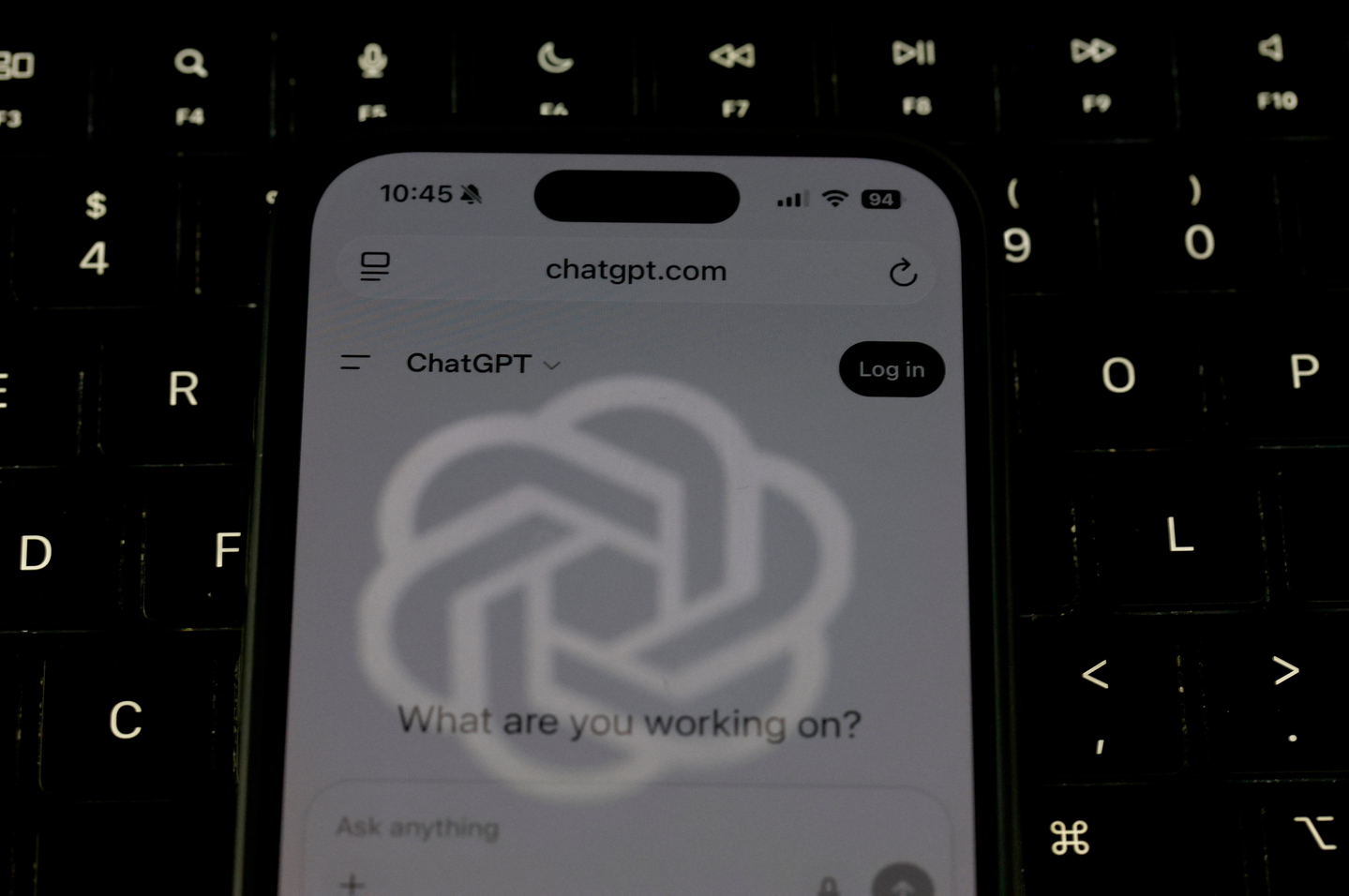
The OpenAI emblem is visible on the smartphone's screen, showcasing the ChatGPT website. [YONHAP]
The memo was received roughly a week prior to the deadline: Each team was required to submit at least one concept to the company's internal AI transformation contest. For the staff, this meant pausing their regular tasks to come up with ideas on request.
They limit the use of AI in daily tasks, mentioning security issues, yet they still want us to generate suggestions," said an employee at a large domestic retail company. "It only increases the performative burden.
A developer working at a South Korean technology startup took a different approach — fully immersing themselves in AI tools. The employee operated five or six Claude Code sessions at the same time every day, managing various tasks simultaneously, and would let the AI work through the night so they could examine the outcomes the following morning.
One day, while seated in front of their computer, the employee experienced a tightening in their chest. Headaches hindered their ability to focus. The symptoms continued, leading them to ultimately resign.
Their backgrounds highlight an increasing trend within Korean offices, where the push to adopt AI is building up into something that resembles exhaustion rather than progress.
In March, the Boston Consulting Group gave it a name in an article featured in the Harvard Business Review: "AI brain fry" — which refers to the mental fatigue resulting from overusing or closely monitoring AI tools that surpass an individual's cognitive limits. "The cognitive strain from AI contributes to higher employee mistakes, decision fatigue, and increased turnover expenses," the researchers cautioned.
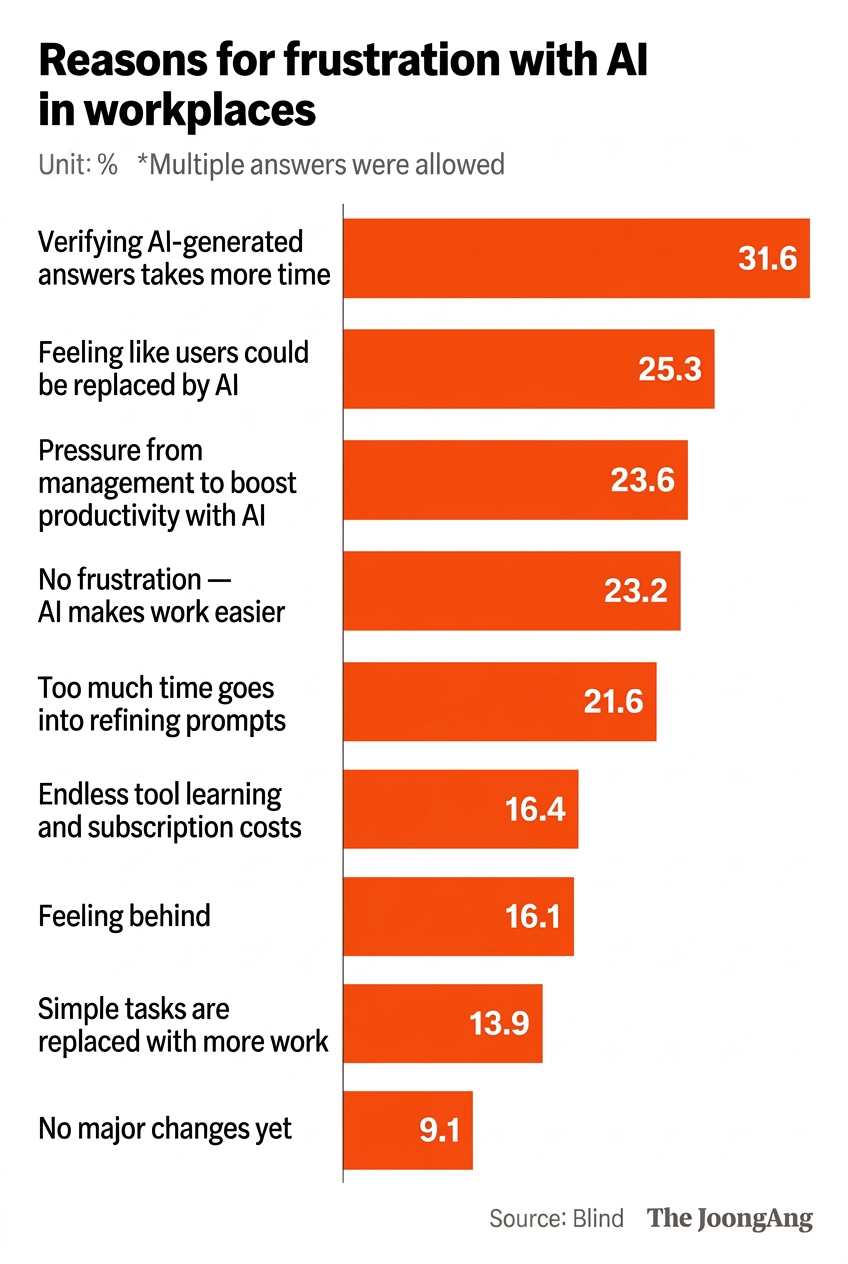
To understand the current sentiment, the JoongAng Ilbo conducted a one-month survey starting April 30 on Blind, a well-known workplace community app among Korean professionals, by asking users: "At what point do you feel most exhausted or receive a reality check while using AI?"
Out of the 5,284 participants, the top choice was "when checking AI results takes more time than doing the task myself," selected by 31.6 percent, followed by "when I think AI could replace me," at 25.3 percent, and "when the company pushes me to boost efficiency using AI," at 23.6 percent.

An individual is typing on a computer keyboard. [AP/YONHAP]
The feedback was equally straightforward. "My KPI is essentially one AI transformation case," an employee at a major corporation wrote. "They're stating that since AI has boosted our efficiency, they're going to reduce our staff. I feel like I'm burying myself."
Another person simply stated that they felt as though they were creating the tool of their own obsolescence.
Another similar term has also gained popularity within online communities this year. In the early part of 2025, a startup employee introduced the phrase "Claude Blue" to characterize the growing sense of psychological despair that arises from the perception that AI is diminishing the professional worth of human employees. The term spread rapidly, leading to an event called "From Claude Blue to Claude Bloom" being organized in April at the Banks Foundation for Young Entrepreneurs, commonly referred to as dcamp, located in Gangnam District, southern Seoul, and supported by Anthropic. Over 2,000 individuals signed up to participate beforehand.
Experts claim that businesses must deeply reconsider the collaboration between humans and AI, instead of just adding AI tools to current tasks. They believe this method is increasing the pressure on employees and causing mental resistance that eventually results in exhaustion.
Many business leaders attempt to make all changes simultaneously, and that's where the issues arise," noted consultant Park Ju-won, who provides guidance to companies on AI strategies. "To achieve a successful AI transformation, it's essential to determine which aspects of the existing workflow are the most predictable and can be modified quickly, then expand incrementally from there.
The article was initially composed in Korean and translated by a bilingual reporter using generative AI technologies. It was subsequently edited by a native English speaker. All translations aided by AI are examined and improved by our news team.
BY HONG SANG-JI [lee.jian@joongang.co.kr]
Post a Comment for ""I'm Digging My Own Grave": AI in the Workplace Sparks Burnout and Despair"