
European Stocks Rise on Strong Regional Economic Data
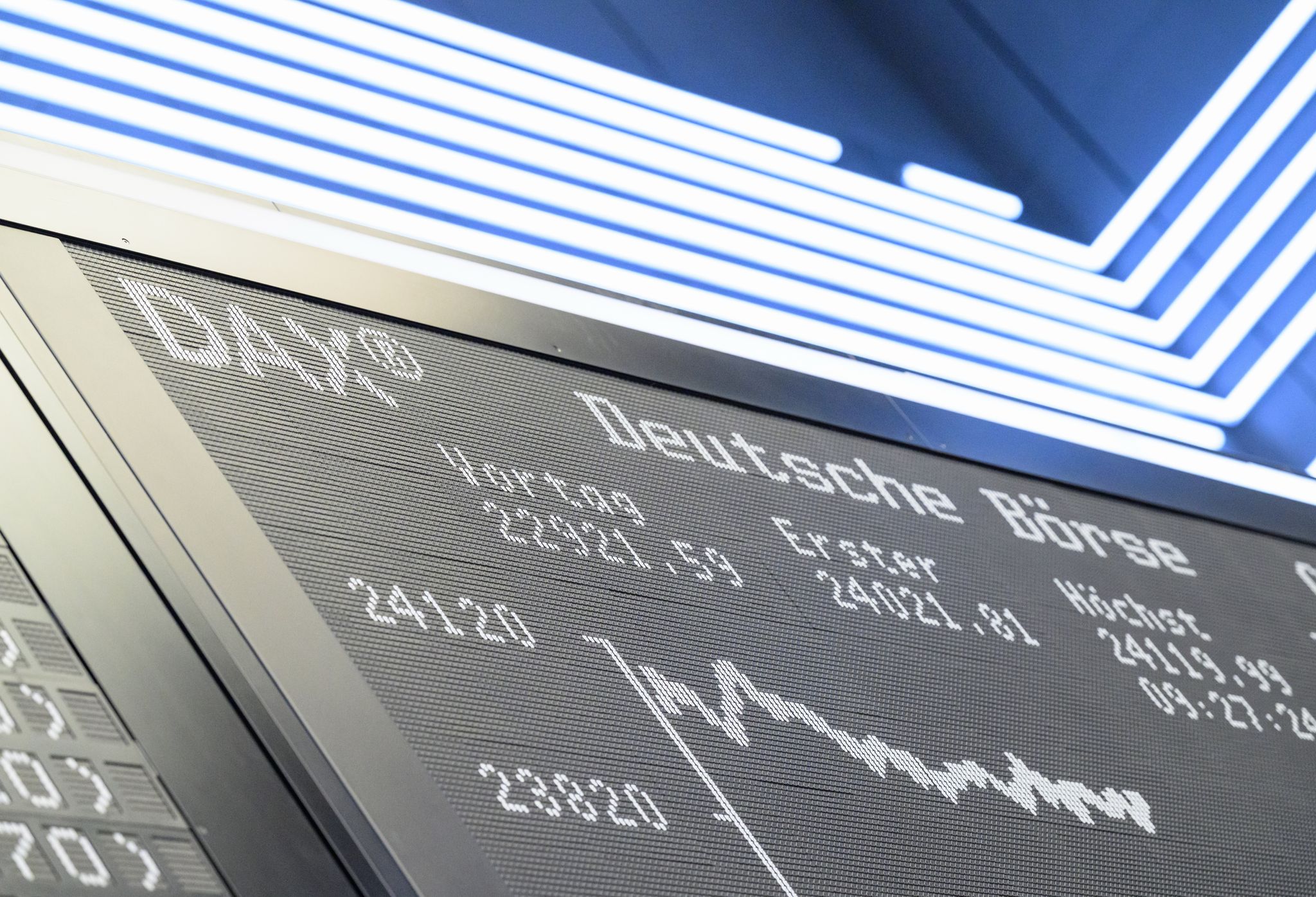
European Stock Markets Show Positive Trends
European stock markets closed on a strong note on Tuesday, driven by encouraging regional economic data and the anticipation that the European Central Bank (ECB) may not increase interest rates soon. Optimism around artificial intelligence also contributed to a positive market sentiment.
Investors were closely monitoring developments on the geopolitical front and paying attention to speeches delivered at the ECB Forum in Sintra. ECB Chief Economist Philip Lane highlighted that the second-round effects from higher energy prices are expected to take time to materialize, and policymakers will not commit to a fixed path for interest rates in the near future.
Despite some uncertainty regarding potential talks between the U.S. and Iran in Qatar, oil prices remained relatively stable.
The pan-European Stoxx 600 index rose by 0.88%, with the UK's FTSE 100 gaining 0.12% and France's CAC 40 increasing by 0.44%. Germany's DAX jumped by 1.5%, while Switzerland's SMI declined slightly by 0.21%.
Regional Market Performance
Several European markets experienced significant gains, including Austria, Belgium, Denmark, Finland, Iceland, Netherlands, Poland, Spain, and Sweden. Ireland and Norway saw modest increases.
On the other hand, the Czech Republic, Greece, Portugal, Russia, and Turkey reported weaker performance.
In the UK market, mining stocks stood out as top performers. Polar Capital Technology Trust increased by approximately 4%, while Babcock International and Scottish Mortgage gained 3.4% and 3.3%, respectively.
Other notable gains included Melrose Industries, St. James's Place, Lloyds Banking Group, Rolls-Royce Holdings, BAE Systems, Lion Finance, Antofagasta, Anglo American, Natwest Group, Halma, IMI, and Croda International, which all moved up between 1.5% and 3%.
However, several companies saw declines, such as Entain, which fell by about 5.5%, and Smith & Nephew, which lost 4.7%. Vodafone Group dropped 3.7%, and BT Group, Burberry Group, Persimmon, Diageo, Metlen Energy & Metals, Airtel Africa, Kingfisher, Centrica, Coca-Cola Europacific Partners, Fresnillo, AstraZeneca, BP, and Unilever also ended the day lower.
German Market Gains and Losses
In the German market, Siemens Energy surged more than 5.5% following a positive outlook on orders during its third-quarter pre-closing conference call on Monday. Bayer also gained around 5.2%, while Siemens, Infineon, and Daimler Truck Holding rose by 4.5%, 4.4%, and 3.9%, respectively.
Other companies that saw notable gains included Rheinmetall, Mercedes-Benz, Continental, Vonovia, Gea Group, Deutsche Post, Fresenius, MTU Aero Engines, Allianz, and RWE.
Deutsche Telekom was among the losers, dropping nearly 4%. Qiagen, SAP, and Volkswagen also saw declines of 1.7% to 2%, while Porsche Automobil Holding and Henkel closed weakly.
French Market Movements
In the French market, Schneider Electric, Safran, ArcelorMittal, Legrand, and Saint-Gobain gained between 2% and 2.7%. Thales, Stellantis, Qiagen, BNP Paribas, Bureau Veritas, Airbus, Accor, AXA, and STMicroelectronics also recorded strong gains.
However, Teleperformance suffered a sharp drop of 11.5%, and Kering closed nearly 7% lower. Capgemini, Publicis Groupe, LVMH, Orange, Pernod Ricard, Dassault Systemes, TotalEnergies, Carrefour, and Hermes International also ended the day in negative territory.
Economic Data Highlights
Data from Destatis showed that Germany's retail sales increased by 1.1% month-on-month in May, reversing a 0.4% decline in April. The food sector saw a 1.1% rise, and non-food sales grew by 1%. Online and mail-order sales increased by 3.4% in real terms.
On an annual basis, retail sales rose by 1.8% after falling 0.6% in the previous month. In nominal terms, retail sales increased by 1% from the previous month and 1.3% from the previous year.
In France, preliminary estimates indicated that the annual inflation rate slowed to 1.8% in June from 2.4% in May, below the expected 2.1%. On a monthly basis, the CPI declined by 0.2%, marking the first drop in five months, largely due to a sharp decrease in energy prices.
Producer prices in France rose by 0.3% month-on-month in May, following a 2% drop in April.
UK Economic Growth
Final data from the Office for National Statistics showed that the UK economy expanded as initially estimated in the first quarter, growing 0.6% sequentially. This followed a revised 0.1% expansion in the fourth quarter. Increased services activity contributed significantly to the growth.
On the production side, output increased across all three sectors, with the largest contribution coming from the services activity, which advanced by 0.8%. Industrial production climbed by 0.2%, and construction grew by 0.2%.
On the expenditure side, household spending rose by 0.6%, and government spending increased by 1.3%.
For 2025, GDP is projected to grow by 1.3%, which is a revision down from 1.4%. This follows an unrevised growth of 1% in 2024.
Post a Comment for "European Stocks Rise on Strong Regional Economic Data"