
From Lab to Sky: Portuguese Graphene Hides Jets and Drones, Revolutionizing Defence
Portugal is making significant strides in the development of a revolutionary material based on graphene, designed to drastically reduce the visibility of drones and military aircraft to radar systems. This breakthrough could place Europe at the forefront of the global race for stealth technology.
The project is spearheaded by GTechPlasma, a spin-off from the Plasma and Nuclear Fusion Institute at Instituto Superior Técnico in Lisbon. The company has created a plasma-based system that produces customised, high-quality graphene materials.
"Currently, our main focus is on developing coatings for radar and electromagnetic radiation absorption," explains Bruno Soares Gonçalves, co-founder of GTechPlasma, in an interview with Euronews.
This innovative material is designed to absorb electromagnetic radiation, including radar waves, which is essential for stealth applications. "The most obvious applications are in the defence sector, but there are many other areas where this type of material has potential for electromagnetic shielding and reducing radiation. That's why we believe we have an extremely interesting material for radar-absorbing coatings," says the researcher from Instituto Superior Técnico. He adds that similar solutions are rare and tightly controlled internationally.
"At present, there is no other solution in Europe, and even worldwide only the United States has one. However, the material that coats the F-35 is not exportable. So we have a material 'made in' Portugal with strong application potential," says Bruno Soares Gonçalves.
Graphene, a sheet of carbon atoms just one atom thick, is produced from precursors such as ethyl alcohol or methane using plasma technology. The team claims that their innovative plasma technology allows them to control the material at an atomic level, enabling its properties to be adjusted for different applications.
Beyond radar absorption, the technology could be used for hydrogen storage or the separation of rare earths and uranium, according to the researcher. "There are many other applications where graphene and its derivatives can be used, but for that you need to control the entire process at an atomic level. And that is what we are able to do with our device, which is patented in the United States, Japan, and Europe," explains the president of the Plasma and Nuclear Fusion Institute.
One of the most important applications is in military aviation, where the goal is to make an aircraft invisible to radar. "Our estimates suggest that an F-16 would have the radar signature of a bird. That means a huge reduction in radar signature, making the aircraft invisible and far more difficult to detect."
Reducing the radar signature can provide a significant strategic advantage in a war scenario. "This becomes important because the aircraft is not detected, or is detected too late, and that is a military advantage. Managing to be picked up as late as possible by radar during military missions is crucial," Bruno Soares Gonçalves tells Euronews.
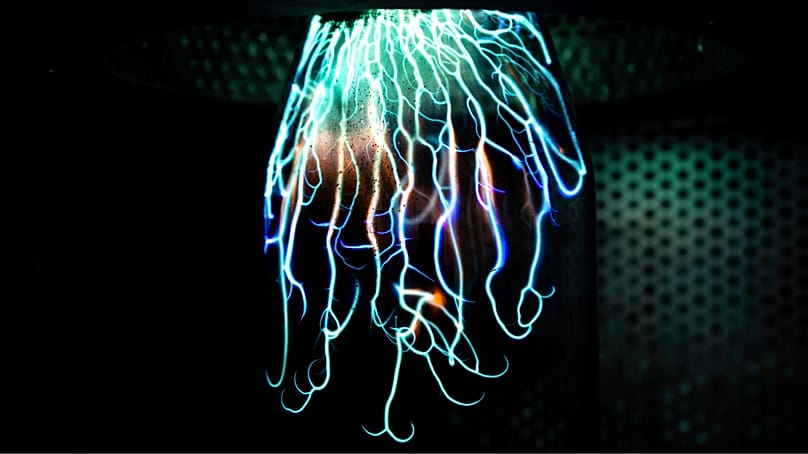
The technology is progressing towards industrialisation, with GTechPlasma’s devices already producing 40 milligrams per minute of high-quality graphene. The company aims to increase its capacity and has already partnered with an industrial partner to scale up production.
Plasmaphene, a company based in Vila Viçosa and funded by Compete 2030, will industrialise the machine for producing high-quality graphene. "Our goal on the factory floor is to have multiple devices, not only because of the redundancy they bring, but also because it allows us to produce multiple materials simultaneously in different devices. In practice, our machine is a platform for multiple materials. We can change the recipe and obtain different materials," the Técnico researcher explains.
The company also plans to expand partnerships with defence-sector firms, having already supplied 260 grams of this radar-absorbing material to a Portuguese drone manufacturer.
At the moment, the material is produced as a very light black powder, but the aim is to develop ready-to-apply solutions, closer to the end user. This includes the development of coatings or paints that can be applied directly to surfaces such as drones.
"The goal is to provide solutions that are as close as possible to something the client can apply, instead of supplying just a powder that the client then has to work out how to integrate," says the GTechPlasma representative.
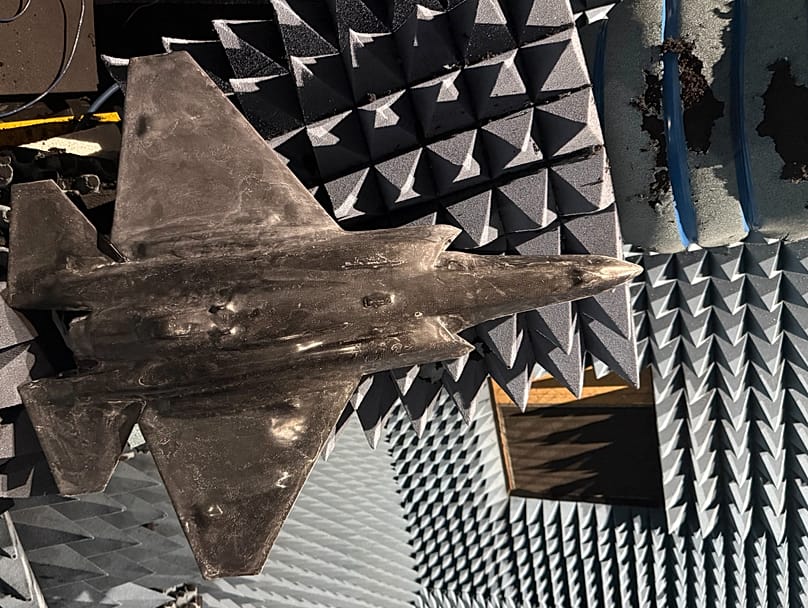
This innovation could position Portugal at the forefront of graphene-based stealth technologies, with application potential extending far beyond the defence sector.
Post a Comment for "From Lab to Sky: Portuguese Graphene Hides Jets and Drones, Revolutionizing Defence"