
Orbitronics Overcomes Major Hurdle with Direct Orbital Currents, Boosting Signals 100x
Breakthrough in Orbitronics Technology
Researchers at Johannes Gutenberg University Mainz (JGU) have made a groundbreaking discovery by directly utilizing orbital currents without converting them into spin currents. This development marks the first purely orbitronic device approach, as highlighted by Dr. Christin Schmitt, a scientist in the research group of Professor Mathias Kläui at the JGU Institute of Physics.
Orbitronics is an emerging technology with the potential to revolutionize future memory devices. It leverages orbital moments, which can be thought of as quantum-mechanical "vortices" of electrons around atomic nuclei, and orbital currents, which are the movement of these circulations through an electrical conductor. The ability to directly use orbital currents could lead to large-scale storage media with extremely low energy consumption.
"For the first time, we have been able to directly couple mobile orbital moments with localized orbital moments in a magnet," said Schmitt. "This achievement represents a milestone in orbitronics and lays the foundation for significantly more energy-efficient data storage. In this way, we obtain signals that are two orders of magnitude stronger than those in conventional spintronic devices."
Collaboration and Publication
Schmitt's work was conducted in collaboration with an international team of over 20 researchers, including members from Forschungszentrum Jülich. The findings were recently published in Science, marking a significant contribution to the field of orbitronics.
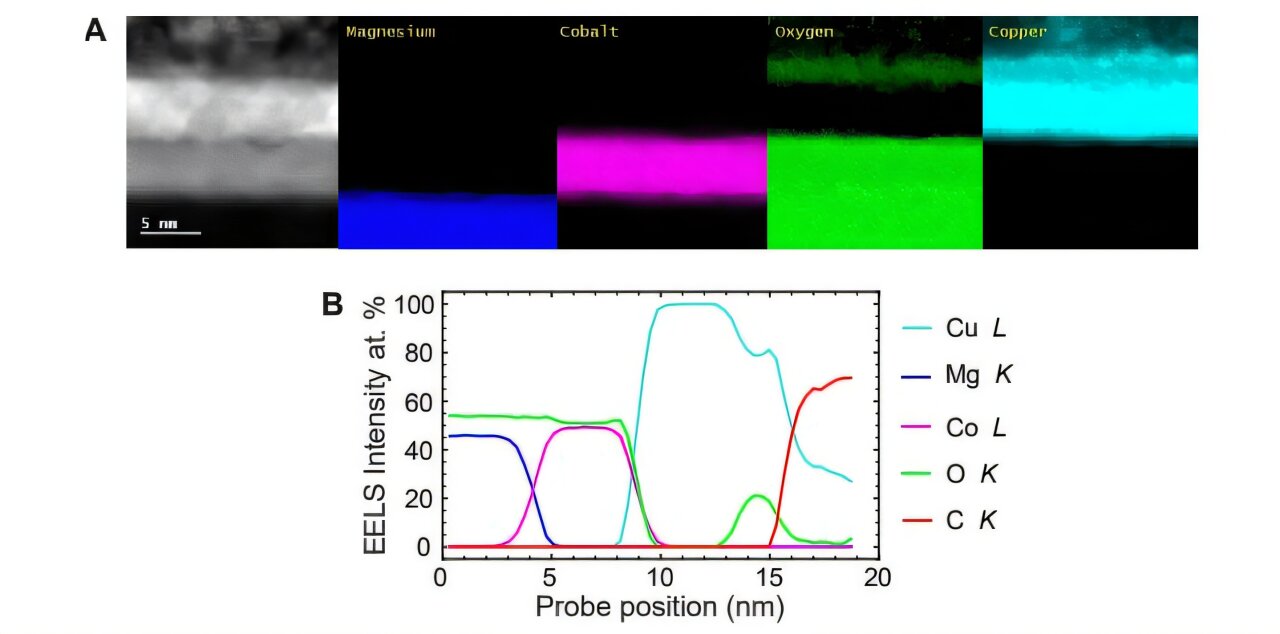
The research focused on a model system involving cobalt oxide with a copper layer. This system served as an insulating antiferromagnet, where the copper reacted at the surface to form copper oxide. The samples used in the study were provided by the research group of Professor Eiji Saitoh at the University of Tokyo.
Advantages of Orbital Currents
Orbital currents offer a significant advantage over spin currents: the measurable signals are orders of magnitude stronger. Using orbital currents to write or read information in magnetic memories could enable more efficient switching processes. In the long term, orbitronics has the potential to produce extremely energy-efficient devices.
Until now, the challenge was that orbital currents had to be converted into spin currents to be used in memory devices. However, Schmitt and her team have succeeded in using orbital currents directly, unlocking the full potential of orbitronics.
Coupling Mobile and Localized Orbital Moments
In their experiments, the team successfully coupled the mobile orbital moments in the copper—which form the orbital current—to the localized orbital moments in the cobalt. This coupling is essential for reading out magnetic information, as the alignment of orbital moments in copper and cobalt determines whether a "0" or "1" is represented.
"The coupling became possible because we used a magnet dominated by orbital angular momentum, whereas previous studies had always relied on spin-dominated magnets," explained Schmitt.
Stronger Signals and New Physical Interactions
The team compared their system with a cobalt oxide/platinum system, where information is stored and read out using pure spin currents. With the orbitronic system, they achieved a signal that was two orders of magnitude stronger than that generated by pure spin currents.
Dr. Sachin Krishnia, a senior member of the research team, emphasized that the effect is not only stronger but also fundamentally different in physical terms. "Beyond the magnitude of the signal, what is crucial is that the orbital current interacts with the cobalt oxide in a completely different way. It does not simply mimic a spin current; rather, it appears to activate hidden properties of the antiferromagnet. This makes orbital magnetism an active degree of freedom for future devices."
Future Applications and Potential Impact
Schmitt sees considerable potential for future applications, stating, "Antiferromagnetic materials with strong orbital properties therefore constitute a good platform for future orbital devices. By enabling more energy-efficient memory and computing technologies, they could help address challenges related to resources, energy consumption, and climate change."
The research opens up new possibilities for the development of advanced memory and computing technologies, leveraging the unique properties of orbital currents. As the field of orbitronics continues to evolve, this breakthrough could pave the way for more sustainable and efficient technological solutions.
For more information, refer to the following publication:
Christin Schmitt et al, Orbital magnetoresistance in the antiferromagnet CoO driven by dynamic orbital angular momentum, Science (2026). DOI: 10.1126/science.adw1808
Post a Comment for "Orbitronics Overcomes Major Hurdle with Direct Orbital Currents, Boosting Signals 100x"