
European armies boast two million troops – yet we still need Trump
European Allies and the Question of US Troop Withdrawal
With a combined strength of over two million soldiers, European allies have long been concerned about the potential withdrawal of US troops from the continent. This concern was heightened when former US President Donald Trump threatened to pull out 5,000 troops from Germany. The move came after German Chancellor Friedrich Merz criticized the US for what he called humiliation in the Iran war. This threat caused panic among NATO officials, who tried to downplay the impact on force projection while raising a broader question: Can Europe manage its own security if the Americans leave?
Despite the numerical strength of European armies, the challenge is not just about having enough soldiers but also about readiness, capability gaps, and the absence of an alternative military command structure.
According to the Military Balance report by the International Institute for Strategic Studies (IISS), the 23 EU members of NATO have 1.29 million active troops. France contributes more than 200,000 personnel, followed by Germany with nearly 180,000 and Italy with more than 160,000. The UK adds another 150,000. Russia has around 1.3 million active personnel, which roughly matches the allies’ active-duty strength. However, Russia has 2 million soldiers in reserve compared to 900,000 in EU countries.
The bloc could potentially call on Ukraine – Europe’s second-largest army with hundreds of thousands of war-hardened troops. Although not a NATO member, Ukraine is a friendly nation, a leading candidate to join the EU, and the continent’s front line against Russia.
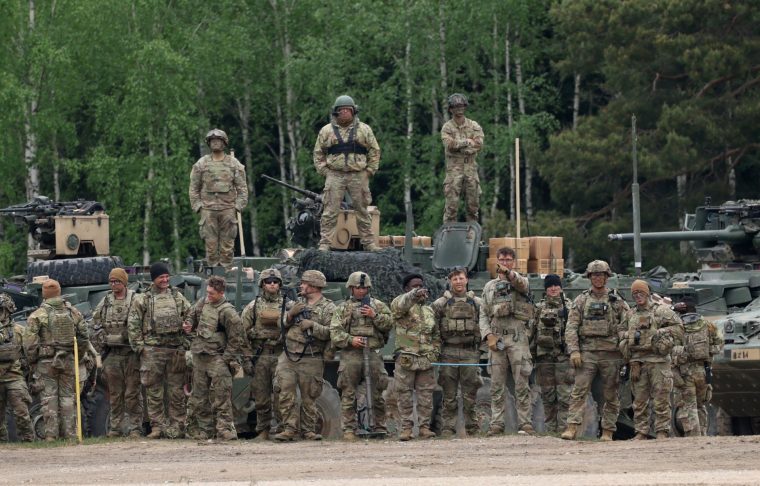
European countries do not primarily need the US because they lack soldiers, but for other reasons such as a lack of readiness, capability gaps, and the absence of an alternative military command structure. To respond quickly, effectively, and at scale when under attack, the alliance has devised the NATO Force Model, a plan that lists the inventory of troops and equipment that must be made available at short notice if a member country is targeted.
Under a three-tier approach, the plan envisages deployment of 100,000 war-ready troops within the first ten days of a war – these would include national troops “in-place” and allied troops nearby. For example, in Estonia it would be primarily Estonians but also contingents from the nearby Tapa base, including troops from the UK, France, and Denmark.
In the second tier, at least 200,000 troops should be deployed between ten days and a month. This force would include heavily armed infantry and armored military units. Within six months, more than 500,000 troops should be ready for action. The plan relies heavily on Washington.
Rafael Loss, a policy fellow at the European Council on Foreign Relations (ECFR), said: “Roughly half of the troops listed in the NATO force model are expected to be Americans.” Trump’s threats to withdraw troops and disengage over time have caused concern over whether the allies can rely on the US to deploy troops for these rapid response teams. Fewer American soldiers could weaken European allies who are already lagging in preparation.
“Training for high-intensity warfare was not a priority for European countries so far,” added Loss. As Americans are often better trained and equipped than their European counterparts, their absence could diminish the mission’s effectiveness. “It depends on specific units, but on average American troops have higher training levels, more ammunition, and better logistics,” said Loss.
The actual number of trained soldiers among the Europeans is “classified,” he said, “but they are estimated to be eight or nine brigades, that’s under 50,000 soldiers.” By contrast, Russia amassed nearly 150,000 troops when it invaded Ukraine in 2022 and is expected to have a larger force for any attacks on a NATO member.
Experts have long recommended that European allies test their troops by organizing surprise snap exercises and unannounced inspection visits to barracks. John R. Deni, a research professor at the Strategic Studies Institute, US Army War College and non-resident associate fellow at NATO Defense College, wrote in 2024: “To avoid the potential pitfalls and ensure the Alliance fulfills its vision, NATO and its member nations ought to consider an array of mitigating steps, such as using snap exercises and inspection visits to ensure forces are indeed manned, trained and equipped, and emphasizing mass and capacity in Allied acquisition plans.”
The absence of US assets could slow down troop deployment. Europe still depends heavily on the US for rapid transport, enemy surveillance, secure communication, and effective combat, said Bence Nemeth, a Senior Lecturer in the Defence Studies Department at King’s College London. “The most serious gaps are not necessarily only in terms of the number of tanks or infantry personnel, but in terms of crucial enablers like strategic lift, intelligence and surveillance, air-to-air refueling, command-and-control, and suppression of enemy air defences,” he said. “Without these American capabilities, European reinforcement in a major war would be slower to arrive and would be more vulnerable and much harder to sustain.”
But the biggest obstacle European allies face is a lack of unity, integrated defense systems, and force structure, analysts believe, as leadership has generally been left to Washington. In a recent paper published by Brussels-based think tank Bruegel, scholars argued that the US troops can be expected to wield greater combat power than an equivalent number of European troops because they “come in large, cohesive, corps-sized units with a unified command.”
Europeans countries face coordination problems and have depended on a US-led command and control to bring them together. Others point to mistrust among European powers and the need of an integrated defense policy. “European allies are beginning to take on greater responsibility for operational-level command within NATO,” said Nemeth. “But we do not yet know whether the French would be comfortable operating under British command, or the British under German command, in the same way they have traditionally accepted American command.”
Post a Comment for "European armies boast two million troops – yet we still need Trump"