
How 'Bazooka Charlie' Destroyed Tanks with an Observation Plane
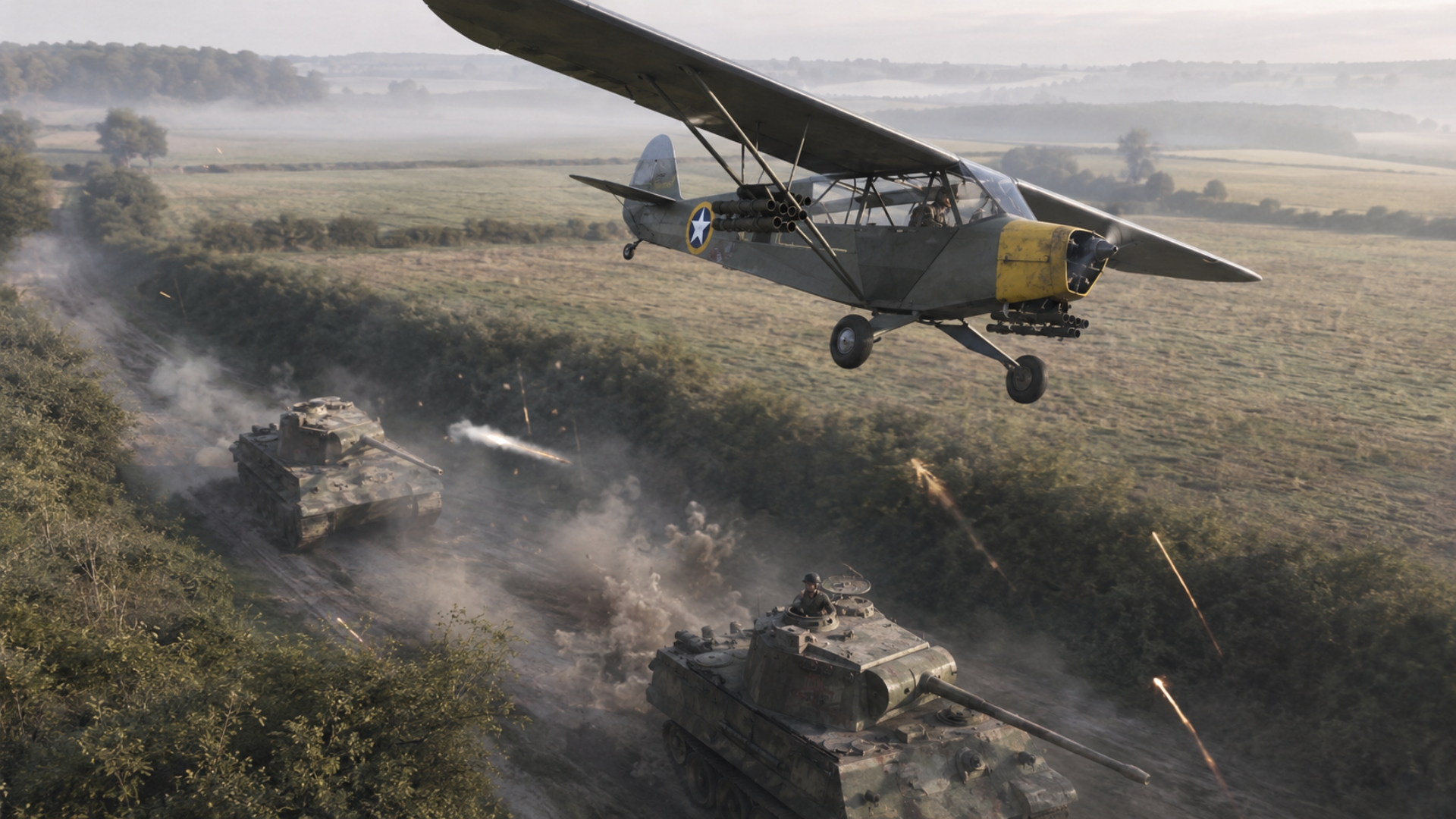
The Observation Plane That Was Not Supposed to Fight
The Piper L-4 Grasshopper was not built to hunt tanks. It was a liaison and artillery-spotting aircraft: small, slow, light, and fragile. Its purpose was to observe the battlefield, adjust artillery fire, carry messages, and move officers or documents short distances. It was useful because it could fly from rough strips and see what ground commanders could not.
It was not armored. It was not fast. It was not meant to dive on German armor. That is what made Charles Carpenter’s idea so strange. He took an aircraft the enemy often treated as a nuisance and fitted it with bazooka launchers. Smithsonian Air & Space Magazine describes Carpenter as an L-4 pilot who became known as “Bazooka Charlie” for his attacks on German tanks, and notes that his plane, “Rosie the Rocketer,” was later rediscovered and restored.
The concept was almost absurd. That did not mean it could not work.
Arracourt Was a Battle of Fog and Armor
The setting was the Battle of Arracourt in September 1944. German armored forces counterattacked near Lorraine, hoping to hit the U.S. 4th Armored Division and disrupt the American advance. The fighting unfolded across rolling farmland, villages, hedgerows, and foggy morning ground where visibility could collapse quickly. That fog mattered.
German Panthers were dangerous in open fighting. Their long 75mm guns and strong frontal armor gave them a major advantage over standard Shermans in many direct engagements. But the terrain and weather around Arracourt reduced visibility and made coordination difficult for both sides. American forces compensated with better tactical coordination, artillery, tank destroyers, aggressive armored crews, and air support when weather allowed.
Carpenter’s armed L-4 was one small but memorable part of that larger fight.
Carpenter Was a Teacher Before He Was “Bazooka Charlie”
Charles Carpenter was not a fighter ace in the usual sense. He had been a teacher before the war and served as an Army observation pilot in Europe. His usual job was to spot enemy movement, report coordinates, and direct artillery. But watching German armor move against American troops from above was not enough for him.
Carpenter reportedly mounted bazookas on his L-4 after hearing of similar experiments by other pilots. The standard bazooka was light enough to attach to the aircraft’s struts, but the setup was crude and unofficial in spirit even when tolerated by units that needed results. The L-4 did not become a proper attack aircraft. Carpenter made it into one by force of improvisation.
That distinction matters. Rosie the Rocketer was not a design program. It was a battlefield answer to a battlefield frustration.
The Bazookas Changed What the Cub Could Threaten
The M1 and later M9 bazookas gave infantry a portable shaped-charge weapon against armor. Mounted on a light aircraft, they became something different: a short-range aerial anti-armor weapon. The idea was risky because the pilot had to get close and aim the entire airplane. There was no bombsight, no armor protection, no second crewman guiding the attack.
Standard accounts of the bazooka’s aviation use note that L-4 Grasshoppers were sometimes field-fitted with bazookas on the lift struts, and that Carpenter eventually mounted six launchers, three per side, on his L-4H. The rockets could damage or destroy vehicles if they hit vulnerable areas. Against a Panther, the best chances came from side, rear, or top angles rather than the strong frontal armor.
That is where the airplane helped. Carpenter could attack from above or from unexpected directions.
The Plane’s Weakness Became Its Protection
The L-4’s weakness was also part of its strange advantage. German troops did not initially see it as a tank killer. A slow observation plane circling overhead usually meant artillery spotting. It was annoying, but not necessarily an immediate anti-armor threat. That assumption gave Carpenter a brief window of surprise.
His aircraft was also small and low-speed. It could fly close to the ground and use terrain in ways larger fighters could not. But none of that made it safe. Once German infantry and armor understood what the little aircraft could do, they could fire rifles, machine guns, and light anti-aircraft weapons at it. The L-4 had no real margin for damage. A few bullets through fabric might be survivable. A hit to the engine, fuel system, or pilot might end the flight immediately.
Carpenter was betting that surprise, low altitude, and nerve would compensate for the lack of protection.
The Kill Claims Should Be Treated Carefully
Carpenter’s battlefield record became famous quickly. Wartime and later summaries often credit him with destroying several enemy vehicles, including tanks. The American Heritage Museum states that Carpenter mounted six bazookas on his L-4 and was credited with destroying six German tanks and destroying or disabling several armored vehicles.
As with many World War II air-to-ground claims, exact totals can be difficult to verify with complete certainty. Smoke, battlefield confusion, abandoned vehicles, later artillery fire, and shared claims can complicate the record. But the larger fact is well supported: Carpenter’s bazooka-armed L-4 attacked German armored vehicles and became famous enough during the war to earn him the nickname “Bazooka Charlie.”
The precise number matters less than what the Germans learned. The harmless Cub was no longer harmless.
The Cub That Made Tanks Look Up
Charles Carpenter did not prove that observation planes should replace fighter-bombers. He proved something narrower and more human: a weapon does not always have to be used the way it was designed. A fragile airplane, a handful of bazookas, and a pilot unwilling to remain only an observer could create a threat the enemy did not expect.
Against Panthers, Shermans needed tactics, teamwork, artillery, terrain, and nerve. Carpenter added one more problem for the Germans. A tiny aircraft overhead might no longer be just watching. It might be hunting.
Post a Comment for "How 'Bazooka Charlie' Destroyed Tanks with an Observation Plane"