
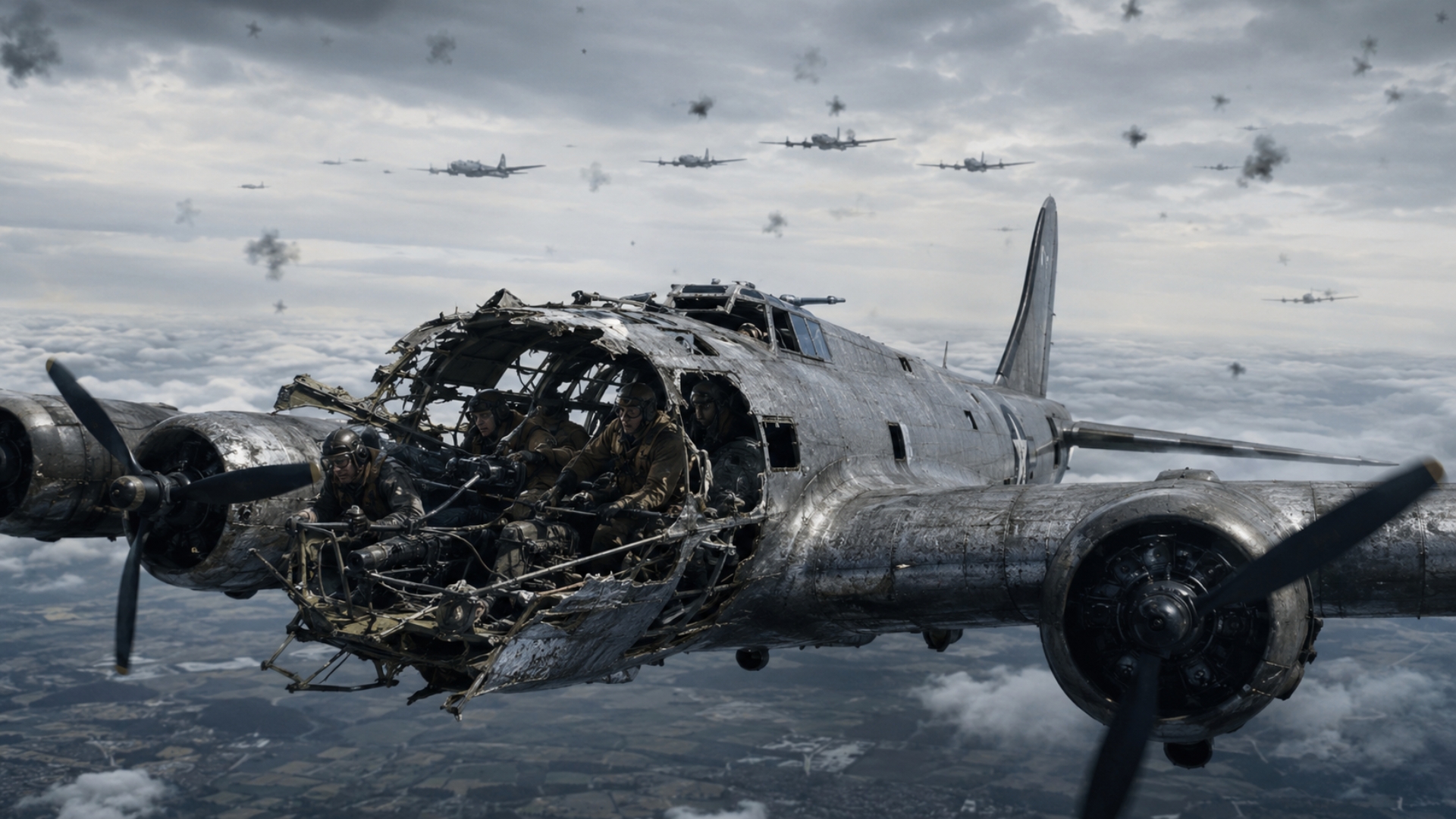
The Unlikely Survival of a B-17
At high altitude over Budapest, the B-17 was doing what heavy bombers were forced to do over defended targets: fly straight and level through flak. This was the terrible vulnerability of daylight bombing. To hit rail yards, refineries, bridges, or industrial targets, bomber formations had to hold course long enough for bombardiers to release accurately. Anti-aircraft gunners on the ground understood this and filled the projected path of the formation with timed bursts.
One shell changed everything. An 88-millimeter round struck the front of the aircraft and destroyed the nose section. The bombardier and navigator were killed instantly. The Plexiglas nose, forward structure, instrument panel, and much of the normal flight-control access disappeared in a single blast. The aircraft should have fallen apart. Instead, it kept flying.
The Bomber Was Alive but Almost Uncontrollable
The loss of the nose did more than expose the cockpit to wind. It changed the aircraft’s balance. Weight vanished from the front of the bomber, forcing the B-17 to pitch upward and threaten a stall. At altitude, with freezing air blasting through the open cockpit and the instrument panel gone, the pilot no longer had the usual references or controls needed to fly safely.
Evald Swanson had to judge the aircraft by sight and feel. That meant watching the horizon through the empty space where the nose had been, using engine power to influence attitude, and trying to keep the bomber from climbing too steeply, rolling, or dropping into an unrecoverable descent. The B-17 was not being flown normally. It was being kept from dying.
The Control Cables Became the Only Hope
Behind the cockpit, the surviving crew discovered what made survival possible. The control cables running through the aircraft were exposed. These cables normally connected the pilot’s controls to the elevator, rudder, and ailerons. With the cockpit torn open, the usual interface was gone, but the physical cables were still present. That meant the crew could try to manipulate them directly.
It was a desperate solution. The cables were not designed to be handled by men in flight. They were under tension, vibrating in the slipstream, and difficult to grip. Pull too hard and the aircraft might overcorrect. Ease off too much and the wind or damaged structure could take over. Still, the bomber responded. Barely.
The Crew Became the Flight-Control System
For several minutes, the men inside the damaged B-17 became part of the aircraft. They gripped the exposed cables, braced their feet against the floor, and pulled by feel. Swanson, isolated up front, adjusted power and watched the horizon. The crew in the fuselage could not see what he saw. He could not see what they were doing. There was no proper communication. The intercom was gone. The wind noise was overwhelming. Corrections had to be learned through pressure, movement, and instinct. When the aircraft dipped, rolled, or yawed, the men holding the cables felt it through their hands and bodies.
It was not procedure. It was improvisation at the edge of disaster.
A Second Hit Made Survival Even Harder
The damaged bomber did not immediately escape danger. Flak continued around it, and another shell struck engine number two. Losing an engine made the aircraft even harder to control. Now the bomber had the drag of a missing nose, the instability of damaged structure, the loss of instruments and normal controls, and the asymmetry of one dead engine. The formation could not slow down for them. That was the rule of bomber warfare. A crippled aircraft that fell behind became a target, but the formation’s survival depended on staying together. The B-17 was alone, damaged, slowing, and still over enemy-held territory.
The crew was no longer trying to complete a mission. They were trying to stay alive long enough to leave the aircraft.
The Tail Was Starting to Fail
The longer the bomber flew, the more the airframe suffered. The tail section began showing signs of dangerous stress. A B-17 depended on its tail for stability. If the tail failed, the aircraft would likely enter a violent, unrecoverable fall. With the nose destroyed and the structure compromised, every correction and every gust increased the strain. The crew faced a brutal conclusion. They could not save the bomber. They could only keep it flying long enough for men to bail out. That changed the purpose of every second. The aircraft was no longer a vehicle to be brought home. It was a temporary platform for survival.
The Fortress That Could Not Come Home
Evald Swanson’s B-17 did not return to base. It crashed and burned far from the target. Two crewmen were killed. The survivors became prisoners. In the official arithmetic of the air war, it was another bomber lost over Europe. But within that loss was something extraordinary. A cockpit vanished. A crew found the control cables. A pilot stayed until the others could jump. For a few impossible minutes, the B-17 was no longer flown by instruments, yokes, or procedures. It was flown by hands wrapped around steel and men who understood that survival sometimes means holding on just long enough for someone else to live.


No comments:
Post a Comment