
The Thunderbolt's Shocking Capture That Stunned German Pilots
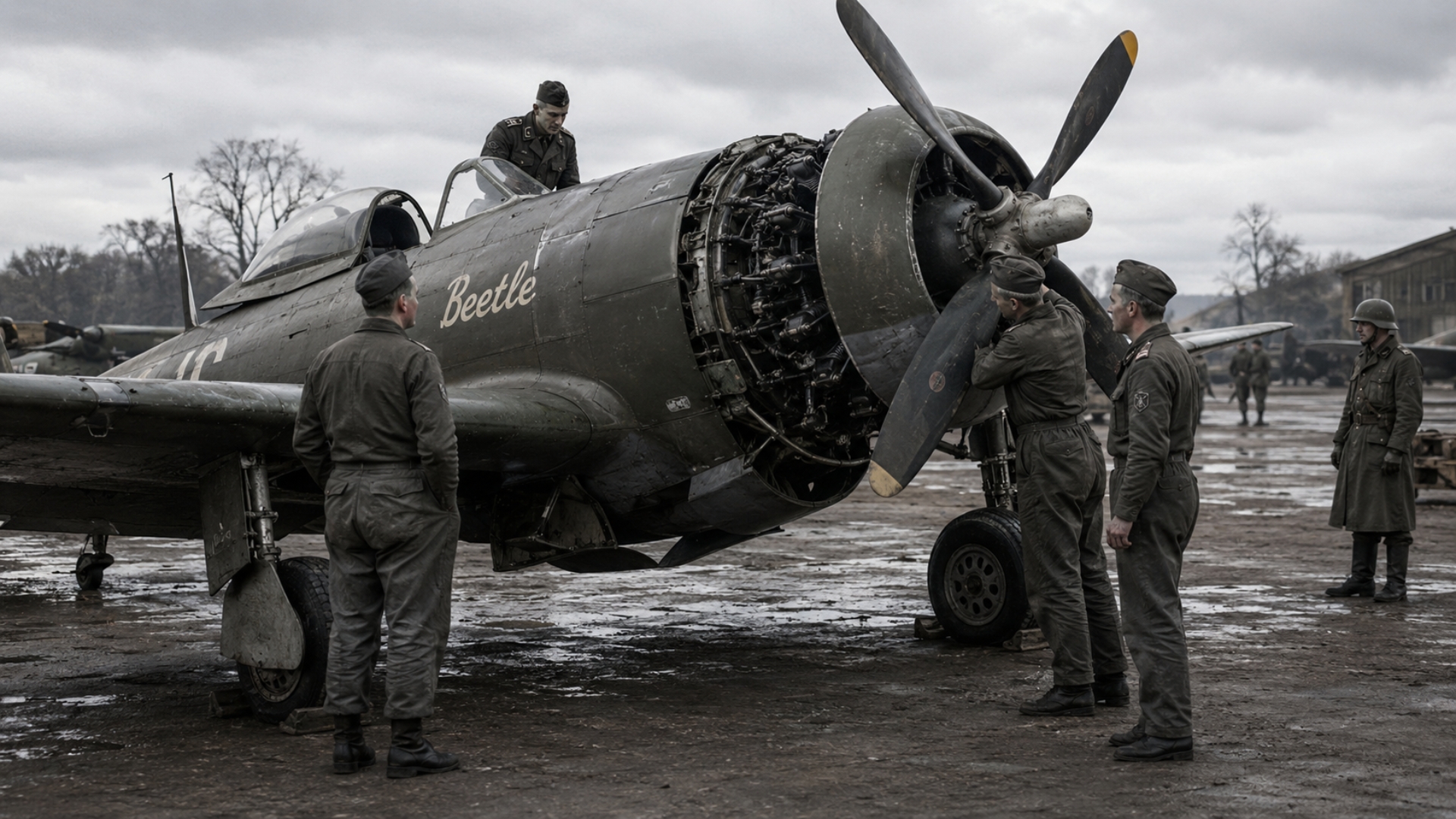
The American Fighter That Landed In The Wrong Country
On November 7, 1943, a P-47D Thunderbolt flown by Second Lieutenant William E. Roach of the 358th Fighter Squadron, 355th Fighter Group, landed at Caen-Carpiquet in occupied France. Roach appears to have mistaken the German-held airfield for a friendly one after becoming disoriented during the mission. The captured aircraft was P-47D serial number 42-22490, coded YF-U and known as Beetle. Captured-aircraft records identify it as belonging to the 358th Fighter Squadron and record its capture at Caen-Carpiquet on November 7, 1943.
For the Luftwaffe, this was not just another crashed enemy aircraft. It was an intact American fighter with its engine, cockpit, systems, and weapons available for study.
Rechlin Wanted More Than A Trophy
Germany’s test center at Rechlin existed to turn captured machines into usable intelligence. A wreck could reveal structure, armor, guns, and manufacturing methods. An intact aircraft could reveal much more: handling, engine behavior, cockpit workload, speed, climb, dive characteristics, and the exact strengths and weaknesses German pilots needed to know.
The man associated with many of these captured-aircraft evaluations was Hans-Werner Lerche, a Luftwaffe test pilot whose memoir was later published in English as Luftwaffe Test Pilot: Flying Captured Allied Aircraft of World War II. The Imperial War Museum catalog records the English title and notes that it was first published in German in 1977.
Lerche’s value was not just that he could fly. He could fly and explain what the machine was doing.
The Cockpit Was The First Surprise
The P-47 was not a crude aircraft. It was complex in a very American way. Later summaries quoting Lerche’s account note his observation that the P-47 cockpit could baffle even an experienced pilot, especially because of unfamiliar controls and systems such as the flap arrangement.
That reaction did not mean the Thunderbolt was badly designed. It meant it had been designed around a different philosophy. German fighter cockpits, especially in the Fw 190, aimed to reduce pilot workload through automation. The Fw 190’s engine-control system coordinated several functions through one main power lever. The P-47 gave the pilot more direct authority over multiple systems: throttle, propeller, turbo-supercharger, intercooler, fuel selection, cowl flaps, gun heating, and emergency power.
To an American pilot trained on the type, that complexity was manageable. To a German pilot encountering the aircraft cold, it demanded study.
The Thunderbolt Was Built Around Its Engine
The P-47’s size made sense only when understood around its powerplant. The aircraft used the Pratt & Whitney R-2800 Double Wasp, an 18-cylinder radial engine, combined with a turbo-supercharger system that helped it maintain power at high altitude. The Thunderbolt’s large fuselage and deep belly were not wasted bulk. They housed ducting, turbo-supercharger equipment, and systems that made the aircraft dangerous in the altitude band where American heavy bombers operated.
Modern summaries of the P-47 emphasize that its turbo-supercharged engine gave it strong high-altitude performance, while pilots also valued its dive speed and ruggedness. This was the key to the aircraft. At low altitude, the P-47 was heavy and not especially graceful. At high altitude, it became much more difficult for German fighters to handle.
Germany Needed To Know The Envelope
By late 1943, the Luftwaffe had already fought P-47s over Western Europe. German pilots knew the Thunderbolt was large, fast in a dive, and dangerous when it held altitude. But combat reports could only go so far. Rechlin wanted numbers: speed at different altitudes, engine response, dive behavior, control feel, cockpit workload, and the point at which German fighters had the advantage.
The captured Beetle gave German engineers a way to measure what pilots had been reporting. That mattered because the air war was changing fast. In 1943, the Eighth Air Force’s bomber offensive depended on fighter escort range. Every improvement in drop tanks moved the point at which German interceptors could safely attack unescorted bombers farther east. An intact P-47 helped German analysts understand the escort threat they were already facing.
The P-47 Was Not A Turning Fighter
The Thunderbolt’s weaknesses were as important as its strengths. It was large, heavy, and not well suited to slow turning combat against more agile German fighters at lower altitudes. A P-47 pilot who tried to fight like a Spitfire or a Bf 109 could get into trouble quickly. But that was not how the best P-47 pilots used it. They fought with altitude, speed, diving attacks, and energy. They avoided low-speed turning fights and used the aircraft’s weight and strength to disengage in dives. This matched the way German pilots learned to treat it: pull it down, force it to turn, and deny it the high-altitude diving fight where it was strongest.
The Rechlin evaluation did not reveal an invincible aircraft. It revealed a conditional one — deadly when used correctly.
The Thunderbolt Germany Could Measure But Not Match
The capture of Beetle gave the Luftwaffe something rare: a living enemy aircraft instead of wreckage. German engineers could fly it, measure it, study it, and explain it. They could identify where it was vulnerable and where it was formidable. They could turn those findings into tactical advice for pilots still fighting over Europe.
But the deeper lesson was harder to use. The P-47 represented a kind of war Germany was increasingly unable to match: complex machines built reliably in large numbers, supported by long training pipelines, fueled across an ocean, and improved month by month. Lerche could measure the Thunderbolt precisely. What Germany could not do was stop the system that kept sending more of them.
Post a Comment for "The Thunderbolt's Shocking Capture That Stunned German Pilots"