
Swift Mission: Science and Defence Opportunity
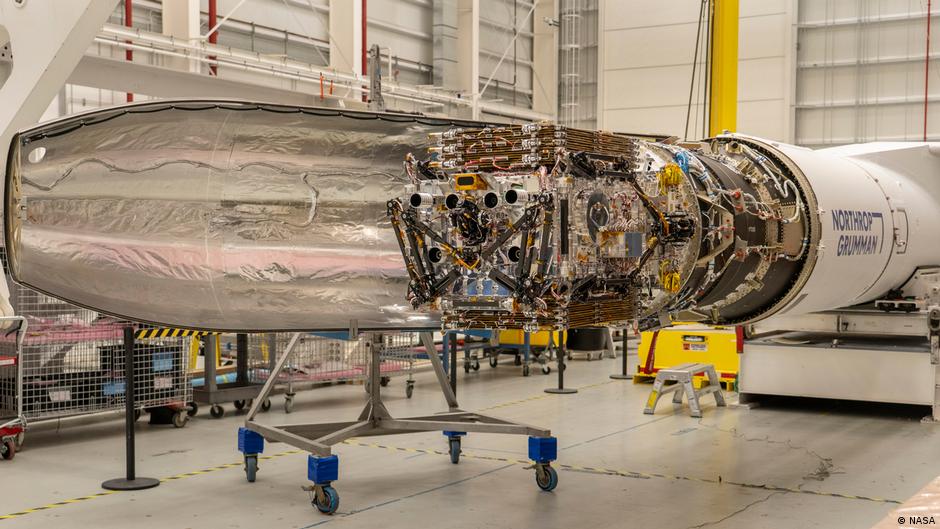
Despite the challenges faced by US government agencies under the Trump administration, including budget cuts and restricted access to websites, NASA continues to be a leader in innovation. The agency is currently working on an emergency mission to rescue a two-decade-old space-based telescope, the Neil Gehrels Swift Observatory. This mission has been designed and developed in just a year and will be launched from the belly of an airplane.
The mission involves a robotic spacecraft called LINK, which will boost the Swift Observatory back into its orbit. The spacecraft is packed into a Pegasus XL rocket, the world's only airborne-launched rocket. This mission represents a significant step forward for NASA, as it is the first time such an attempt has been made.
Brad Cenko, the Principal Investigator for Swift at NASA, described the mission as a great opportunity to try something novel with real scientific benefits. He emphasized that while the mission may fail, not attempting to save Swift would result in the telescope re-entering Earth’s atmosphere in an uncontrolled way by the end of this year.
Why Save the Neil Gehrels Swift Observatory?
The primary reason for saving the Swift Observatory is its scientific value. According to Cenko, the mission is about "saving for science," but it also makes financial sense. While building a new and improved version of Swift would cost significantly more than the $30 million (€26 million) boost, the original mission cost about $250 million to build and launch in 2026 dollars. This makes the current effort a cost-effective solution.
Swift was originally designed to study gamma-ray bursts, which are powerful explosions in the universe. These events occur when stars explode or celestial objects collide. By studying gamma rays, scientists can determine how certain chemical elements form.
"Swift has been extremely successful in this regard, detecting over 2,000 of these sources all the way out to the edge of the visible universe," said Cenko. "It has helped confirm that most of the heaviest elements in the periodic table, like gold and platinum in our jewelry, are forged in these systems."
Over the past 20 years, Swift has evolved into an "astrophysics multitool" capable of surveying radiation across multiple parts of the spectrum, including visible, ultraviolet, X-ray, and gamma-ray.
"The universe is an incredibly dynamic place," said Cenko. "Somewhere in the cosmos, a massive star explodes every second. Hubble takes at least 1-2 days to repoint at a target of interest. Swift routinely conducts follow-up of things that go bump in the night within minutes. It is NASA's first responder."
Originally launched into an orbit about 600 kilometers above Earth’s surface, Swift has since lost more than 220 kilometers of altitude. Experts believe this is due to increased solar activity, such as solar flares, which create extra drag on spacecraft circling the Earth.
Robotic Servicing: How LINK Will Boost Swift
The central piece of the Swift Boost Mission is a robotic servicing spacecraft called LINK, developed by Katalyst Space, a commercial company in the United States. Because Swift is falling so fast, the firm had only a year to design, build, test, and now launch the spacecraft.
LINK will launch from a Northrup Grumman Stargazer L-1011 aircraft using a small Pegasus rocket. The rocket measures 17.6 meters in length and will be released from about 40,000 feet over an open area of ocean. After a five-second freefall, the rocket will ignite its first of three motor stages.
Once LINK is released into space, Katalyst will need to establish a signal between the spacecraft and ground control, then perform tests for several weeks before moving the servicing spacecraft towards Swift. It could take another month before LINK latches onto Swift, as the telescope was not designed with docking ports or grappling fixtures. NASA compares the difficulty of the maneuver to landing on an asteroid.
If successful, LINK will fire three electric propulsion thrusters to raise the telescope over several months. This mission represents new technology in the field of on-orbit servicing (OOS) in the US and in-space operations and servicing (ISOS) in Europe.
"There are broad commercial and defense applications for robotic servicing," said Cenko, referring to a growing trend towards dual-use technologies in space—technologies that serve both civilian and military purposes.
If the orbit-boosting mission goes as planned, Swift will resume science operations until its planned end of operation in 2030.
Europe's Eyes on In-Space Operations and Servicing
The European Space Agency (ESA) is also working on dual-use in-space operations and servicing technology. Similar to NASA, ESA emphasizes that these efforts support its domestic commercial space industry.
"We are working on a portfolio of technologies for rendezvous and capture," said Berengere Houdou, Head of ESA's Space Safety Missions Office. "For example, space sensors and image processing algorithms for autonomous navigation to know the position of a target satellite and robotic arms to seize and secure it."
Houdou noted that these technologies are essential for the next era of space operations and that there are indeed synergies with dual-use applications.

Post a Comment for "Swift Mission: Science and Defence Opportunity"