
Protest in Montgomery Upholds Black Political Voice Against SCOTUS Ruling
A Rally for Justice and Representation
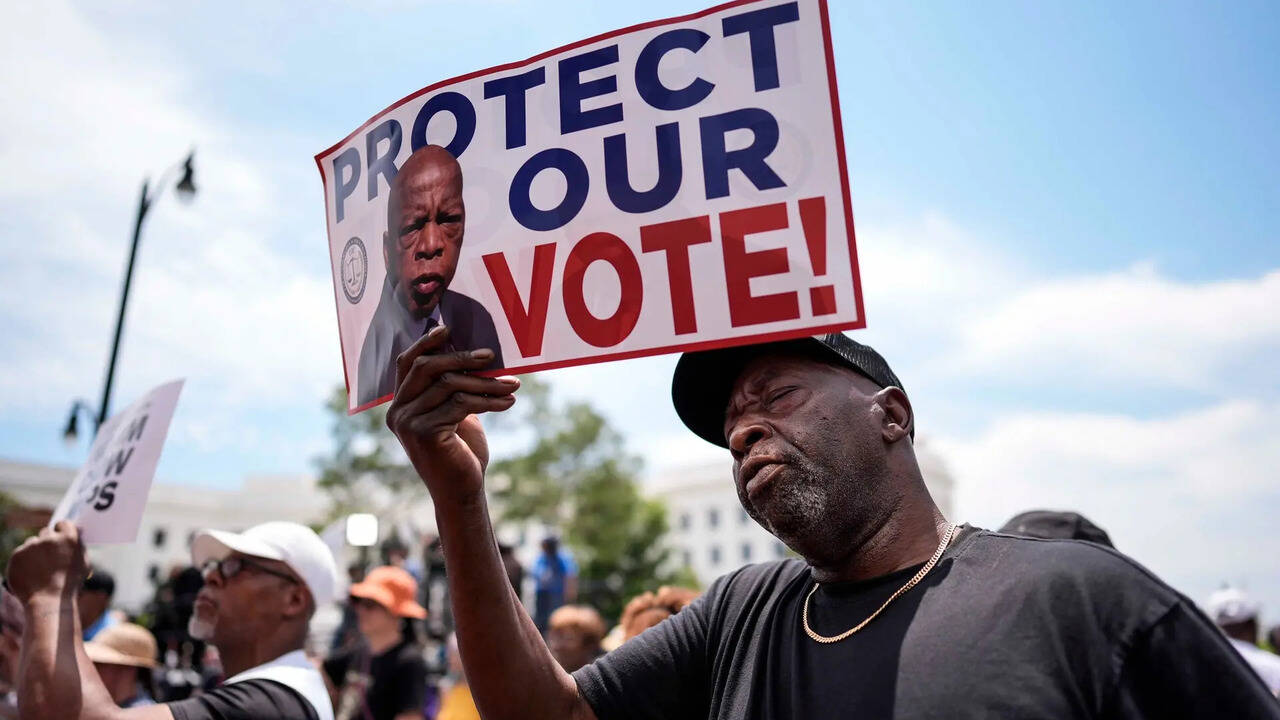
Thousands of people gathered in Montgomery, Alabama, the birthplace of the modern Civil Rights Movement, to stand against efforts by conservative states to redraw congressional districts that have ensured Black political representation. The event was organized in response to a U.S. Supreme Court ruling that weakened the Voting Rights Act, prompting southern states to adjust their district lines. The rally took place at a location where civil rights history was made, emphasizing the need to continue the fight for representation for future generations.
The Rev. Bernice King, daughter of the Rev. Martin Luther King Jr., addressed the crowd near the site where her father spoke during the 1965 voting rights march. She highlighted the impact of the sacrifices made by the civil rights generation, which changed the course of the nation. “Sixty-one years later, we come back as new generations to this same hallowed place to reclaim and redeem that legacy because the recent Supreme Court decision demands our presence,” she said.
King described the ruling as a “moral disgrace and a shameless assault on Black political power.” She noted that the decision strikes “at the very heart of my father’s and my mother’s sacrifice” and is an attack on those who faced violence for the right to vote. The rally, titled “All Roads Lead to the South,” brought together civil rights leaders, Democratic members of Congress, union leaders, and pastors.
A Historical Setting
The crowd gathered in front of the Alabama Capitol, a historical site linked to the Confederacy and civil rights, where the stage was positioned before statues of Confederate President Jefferson Davis and civil rights icon Rosa Parks. This setup illustrated the state's complex history. U.S. Sen. Cory Booker referred to Montgomery as “sacred soil” in the civil rights struggle, while U.S. Rep. Terri Sewell emphasized that the gathering represented a “call to action” rather than a protest.
Speakers urged voters to mobilize at the ballot box. “They think they can draw us out of power. They do not know the sleeping giant that they just awakened,” remarked U.S. Rep. Alexandria Ocasio-Cortez, a Democrat from New York. Attendees endured summerlike temperatures as the rally extended beyond four hours, leading chants of “we won’t go back” and “we fight.”
Reflections on the Past and Present
Some participants reflected on the parallels between current redistricting efforts and historical struggles. Camellia A. Hooks, 70, of Montgomery, said, “We lived through the ’60s. It takes you back. When you think that Alabama’s moving forward, it takes two steps back.”
The recent Supreme Court ruling regarding Louisiana has significantly undermined the Voting Rights Act, which had already faced setbacks since a 2013 decision. This has paved the way for stricter voter ID laws, registration limitations, and changes to early voting and polling locations, particularly in states with histories of racial discrimination.
Concerns Over Erosion of Protections
Civil rights veterans expressed alarm over the rapid erosion of protections established through decades of struggle. Kirk Carrington, 75, recalled his experiences during the 1965 Selma march, saying, “It’s really just appalling to me and all the young people that marched during the ’60s, fought hard to get voting rights, equal rights and civil rights. It’s sad that it’s continuing after 60-plus-odd years that we are still fighting for the same thing we fought for back then.”
Montgomery is set to be affected by the Supreme Court ruling, as it contains one of the congressional districts facing alteration. A federal court in 2023 redrew Alabama’s 2nd Congressional District after determining that the state intentionally diluted the voting power of Black residents, who comprise about 27% of the population. The court mandated the establishment of a district where Black voters could elect their preferred candidate.
However, the Supreme Court allowed for a new map that could enable the Republican Party to regain control of the seat. While litigation continues, the state plans to hold special primaries on August 11 under the new map.
Voices for the Community
U.S. Rep. Shomari Figures, who was elected in the district in 2024, stressed that the issue transcends individual interests, focusing instead on the community’s representation. “People tell us that we are not who we once were,” Figures stated regarding the South. “That is true, but we certainly aren’t where we need to be,” he added.
Alabama House Speaker Nathaniel Ledbetter, a Republican, remarked that the Louisiana ruling offers an opportunity to revisit a congressional map imposed by federal courts. “People tend to forget what happened. When this thing went to court, the Republican Party had that seat, congressional seat two,” Ledbetter explained. “There’s been a push through the courts to try to overtake some of these red state seats, and that’s certainly what happened in that one.”
Shalela Dowdy, a plaintiff in the Alabama redistricting case, affirmed that the struggle will persist both in and out of the courtroom. A three-judge panel has scheduled a hearing on May 22 to address a request to prevent Alabama from implementing the new maps. “We are not going down without a fight. We are not going back to Jim Crow maps,” Dowdy declared.
Post a Comment for "Protest in Montgomery Upholds Black Political Voice Against SCOTUS Ruling"